
Quick answer: Translating an interface isn’t enough: when a left-to-right design is flipped, twelve things break, including mirroring, numbers, fonts, icons, forms, search, product data, dates, mixed-language pages, speed and tone. Arabic-first UX designs those constraints in from the first wireframe, so the English version is the one adapted.
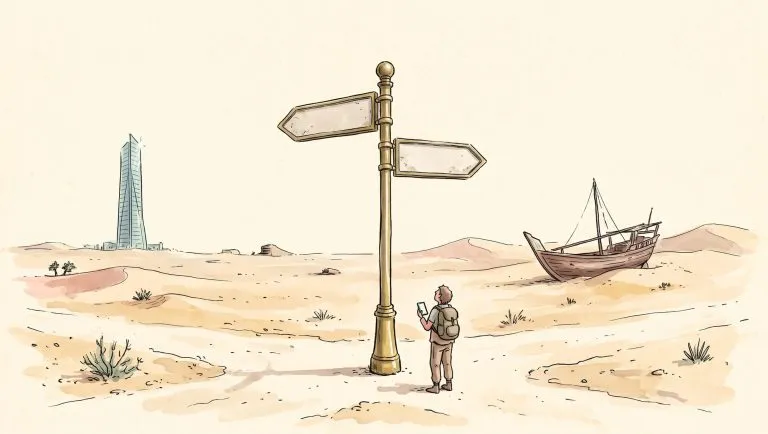
“We’ll add Arabic later” is the most expensive sentence in UAE product design. It sounds like a translation task. It’s a layout, typography, data, search and content task, and every one of those breaks in a specific, predictable way when a left-to-right interface is flipped by a plugin. This article lists the twelve breaks we see most often, why they happen, and what a genuinely Arabic-first build does instead.
Sources: Arabic content trends 2025 · Communicate Online on Arabic content share · GMI UAE population statistics
Why this matters more in the UAE than almost anywhere
Arabic is the fourth most used language on the internet, yet estimates of Arabic content run between one and three and a half per cent of the web. That gap is the opportunity: an Arabic experience that’s actually good stands out, because most of the competition is a machine-translated afterthought. In the UAE the audience is unusual. Expatriates make up roughly 89 per cent of residents, with English as the working language and large Hindi, Urdu, Tagalog and Bengali-speaking communities, while Arabic is the official language, the language of government, of Emirati and wider Arab customers, and increasingly of the Saudi market next door that every UAE brand eventually wants. If you’re building a serious product in this country, you’re building a bilingual one, and Arabic is the harder half.
Sources: Expatriates in the UAE · Top languages spoken in Dubai
Source: UAE Constitution, Article 7 (2004 text)
The twelve things that break

1. The layout mirrors, but the wrong things mirror with it
Right-to-left is a full mirror of the interface: logo to the top right, navigation flowing right to left, back arrows pointing right, progress bars filling from the right, carousels advancing leftwards. Apple’s Human Interface Guidelines and Google’s Material bidirectionality guidance agree on the exceptions: don’t mirror logos, photographs, real-object illustrations, media player controls, clocks and anything that turns clockwise, or map orientation. A CSS direction: rtl switch flips everything, including the things that must stay put.
2. Numbers flip when they mustn’t
Numerals stay left-to-right inside Arabic text: “1,247” reads the same way in both languages. Naive bidirectional handling reverses digit runs, splits phone numbers across lines and turns “AED 1,250.00” into a puzzle. Prices, phone numbers, order IDs and dates need explicit isolation (the Unicode bidi isolate characters or the <bdi> element) so they render as single left-to-right units wherever they sit.
Sources: MDN: the bdi element · W3C: Unicode bidi basics
3. Fonts that were never designed for Arabic
Your brand typeface almost certainly has no Arabic glyphs, so the browser falls back to whatever the device has, usually a system font with a different weight, x-height and rhythm. The Arabic looks heavier or lighter than the English beside it, and line heights jump. An Arabic-first build chooses a paired family (many modern type families ship Arabic companions) and sets separate line-height, letter-spacing and sizing rules for each script. Arabic also has no letter-spacing: tracking Arabic text breaks the connected letterforms.
Source: MDN: letter-spacing, internationalization concerns
4. Text expands and contracts in the wrong places
Arabic strings are often shorter in characters but taller in glyph height, and headings behave unpredictably: a punchy four-word English headline can become two lines of Arabic or one short line. If you size buttons to the English label, they overflow; if you lock hero layouts to English line counts, they collapse. Build components with flexible widths and heights, and test them with real Arabic copy, not lorem ipsum.
5. Icons carry meaning that changes direction
A “next” chevron, a reply arrow, an undo icon, a truck driving rightwards to signal delivery: each communicates direction. In Arabic the chevron must point left, the truck should drive left, but a checkmark, a search magnifier and a play button stay as they are. Use an icon library with an explicit RTL variant set, not a blanket CSS flip.
6. Forms ask for data in the wrong shape
Names don’t split neatly into first and last; many Arab customers give a chain of names. Addresses in the UAE are building, area, landmark and a map pin, not street and postcode. Phone inputs need the country code fixed left-to-right with the number typed in either Arabic-Indic or Western digits. A form copied from a US template rejects valid Arab customers at the exact moment they were about to pay.
7. Search that can’t find Arabic products
Arabic search breaks in three ways at once: the same word is written with or without diacritics, with different forms of alef and taa marbuta, and customers type in either Arabic or Latin transliteration (“ابايا” and “abaya” are the same query). Without normalisation, synonyms and transliteration mapping, the Arabic store’s search returns nothing for common queries, and customers conclude you don’t stock the product.
Source: Apache Lucene: ArabicNormalizer
8. Machine translation of product data
Interface strings translate well enough with a native review. Product data doesn’t: sizes, materials, care instructions and marketing claims come out stilted or wrong, and category names lose the words customers actually use. If you’re building Arabic-first, you treat Arabic product content as content, written or edited by a native speaker, and you store it as a first-class field, not a translation cache.
9. Dates, calendars and weekends
Arabic interfaces need to handle the Gregorian and Hijri calendars where relevant, weekend conventions (the UAE working week is Monday to Friday with a shorter Friday), and Ramadan hours, when delivery windows and customer service times shift. If you hard-code Saturday-Sunday assumptions and a single calendar, you’ll promise deliveries you can’t keep.
Source: SCC Online: UAE government 4.5-day working week (8 December 2021)
10. Mixed-language pages with no bidi plan
Real UAE pages mix scripts: an Arabic product title with an English brand name, an English address with Arabic instructions. Without explicit language attributes on each element (lang="ar", dir="rtl"), browsers guess, screen readers pronounce the wrong language, and punctuation ends up on the wrong side of a sentence. The fix is boring: you mark every mixed run.
Sources: W3C: inline bidi and dir attribute · W3C: language declarations in HTML
11. Performance on the Arabic version
Translation plugins often add a second round-trip, extra scripts and duplicated font loads, so the Arabic page is measurably slower than the English one. On a market where most transactions happen on a phone, the slower version is the one half of your customers see. Arabic and English should render from the same templates, share the same optimised assets, and be measured separately in your analytics.
12. Cultural details that signal care
Imagery, colour, tone of address and holiday moments all signal whether the brand understands the customer. Formal versus informal address in Arabic, respectful representation, Ramadan and Eid campaigns that arrive on time, and copy that doesn’t read as a literal English idiom: none of these are technical, and all of them are visible.
What to mirror and what to leave alone
| Element | Mirror in Arabic? | Note |
|---|---|---|
| Navigation order, breadcrumbs, tabs | Yes | Read right to left; logo sits top right |
| Back, next, forward arrows and chevrons | Yes | They express direction of travel |
| Progress bars, sliders, steppers | Yes | Fill from the right; volume and time sliders too |
| Numerals, phone numbers, prices, codes | No | Keep left-to-right and isolate with bidi controls |
| Logos, brand marks, photographs | No | Never flip a real-world image or a brand asset |
| Media player controls | No | Play, pause and timeline conventions are global |
| Clockwise rotation, undo/redo | Mostly no | Rotation direction is physical; undo/redo follow platform guidance |
| Maps and compass | No | Orientation is geographic; only the UI chrome mirrors |
| Checkmarks, search, share, settings icons | No | Non-directional |
Sources: Mobile app design for RTL languages · Designing for the Arab user · Apple Human Interface Guidelines (Right to Left) · Material Design bidirectionality guidance
Arabic-first UX: how the build changes
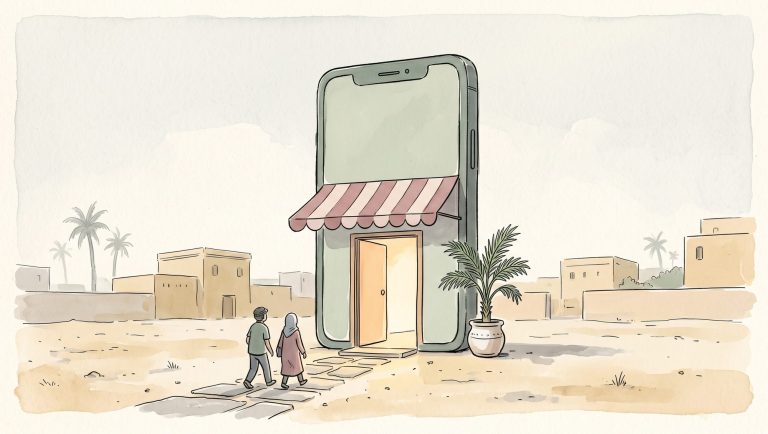
Arabic-first doesn’t mean Arabic-only or Arabic-before-English. It means the constraints of Arabic are designed in from the first wireframe, so the English version is the one that gets adapted rather than the reverse. In practice:
It means the constraints of Arabic are designed in from the first wireframe, so the English version is the one that gets adapted rather than the reverse.
| Layer | Translate-later approach | Arabic-first approach |
|---|---|---|
| Design system | LTR components, flipped by CSS | Logical properties (start/end, not left/right); RTL variants for directional icons; tested in both directions in the component library |
| Typography | One brand font; system fallback for Arabic | Paired Latin and Arabic families with separate size, leading and weight rules; no tracking on Arabic |
| Content model | Arabic stored as a translation of English fields | Every content field is bilingual by schema; Arabic product copy is authored, not generated; slugs and metadata exist in both languages |
| Search | Default database search | Arabic normalisation (alef, hamza, taa marbuta, diacritics), transliteration synonyms, bilingual category names |
| Forms | US-style name and address fields | Single full-name field, UAE address model with map pin, phone input that accepts Arabic-Indic digits |
| QA | English tested; Arabic “spot-checked” | Both languages in the test plan; screenshots of every screen in both directions; native-speaker review before release |
| Measurement | One set of analytics | Language as a dimension on every funnel; Arabic conversion tracked against English, per device |
A quick audit you can run today
Open your Arabic storefront on a phone and tick what passes.
0 of 10
- The logo sits top right and the main navigation reads right to left
- Back and next arrows point the correct way; play, search and checkmark icons aren’t flipped
- Prices, phone numbers and order numbers read correctly and never split across lines
- Arabic headings use a proper Arabic typeface that matches the weight of the English one
- Searching a common product in Arabic and in Latin transliteration both return results
- Product descriptions read like they were written by a person, not a translator
- The checkout form accepts a single full name and a UAE-style address with a map pin
- The Arabic page loads as fast as the English page on a mid-range Android
- Every element that mixes languages carries the right lang and dir attributes
- Ramadan hours, holidays and delivery windows are correct in both languages
Eight or more and your Arabic experience is genuinely competitive. Five or fewer and Arabic-speaking customers are leaving before checkout, whether or not the analytics has a segment that shows it.
If you already launched English-only: a six-week recovery plan
Most UAE brands aren’t starting from a blank page; they have a live English store and an Arabic toggle that nobody trusts. The fix doesn’t require a rebuild. It requires doing the work in the right order so that each week removes a visible failure.
Most UAE brands are not starting from a blank page; they have a live English store and an Arabic toggle that nobody trusts.
| Week | Work | What the customer notices |
|---|---|---|
| 1 | Audit every screen in Arabic on a phone; log the twelve breaks above; fix numerals, phone and price isolation | Prices and numbers stop looking broken |
| 2 | Introduce a paired Arabic typeface; set Arabic-specific sizes and leading; remove letter-spacing from Arabic | The Arabic site looks designed, not defaulted |
| 3 | Swap directional icons for RTL variants; fix carousels, steppers and progress bars; add lang and dir attributes to mixed runs | Navigation feels natural; screen readers behave |
| 4 | Rewrite the top 50 product pages and every category name in Arabic with a native editor; store Arabic as a first-class field | Product pages read like the brand wrote them |
| 5 | Add Arabic search normalisation and transliteration synonyms; rebuild the checkout form for UAE names and addresses | Search finds products; checkout stops rejecting customers |
| 6 | Measure Arabic and English funnels separately; fix the slowest Arabic templates; schedule Ramadan and Eid content | Conversion in Arabic becomes a number you manage |
By the end of week six the store isn’t “Arabic-first” in the purist sense, but it passes the audit above, and the difference in Arabic conversion is usually visible within the following month. If you ever need a rebuild, you can then specify it from real data rather than from the assumption that Arabic customers “just prefer English”.
The business case in one paragraph
Arabic-first costs more at the design stage, roughly the price of a bilingual content model, a paired typeface and a longer QA cycle, and almost nothing more at the build stage if the design system was done properly. What you get is the half of the market that most UAE competitors serve badly, a head start on Saudi Arabia where Arabic isn’t optional, and a product that Arabic-speaking customers describe to each other as “actually works in Arabic”. That sentence is rarer than it should be, and it’s the whole point.
OXEDGE designs and builds bilingual products for the UAE and GCC, from the design system to the search index. If your Arabic experience is a translation layer, talk to us about what it would take to make it a first-class one.
Questions UAE buyers ask
What does Arabic-first mean in UX design?
It doesn’t mean Arabic-only or Arabic-before-English. It means the constraints of Arabic are designed in from the first wireframe, so the English version is the one that gets adapted rather than the reverse.
Why do prices and phone numbers break in Arabic interfaces?
Numerals stay left-to-right inside Arabic text, but naive bidirectional handling reverses digit runs and splits phone numbers across lines. Prices, phone numbers, order IDs and dates need explicit isolation, using the Unicode bidi isolate characters or the bdi element.
Why does search fail on Arabic products?
Arabic search breaks in three ways at once: words are written with or without diacritics, with different forms of alef and taa marbuta, and customers type in Arabic or Latin transliteration. Without normalisation, synonyms and transliteration mapping, search returns nothing for common queries.
Can we fix an English-only store without a rebuild?
Yes. The article sets out a six-week recovery plan that does the work in the right order so each week removes a visible failure. By week six the store passes the audit, and the difference in Arabic conversion is usually visible within the following month.
Does an Arabic-first build cost more?
It costs more at the design stage, roughly the price of a bilingual content model, a paired typeface and a longer QA cycle. It costs almost nothing more at the build stage if the design system was done properly.