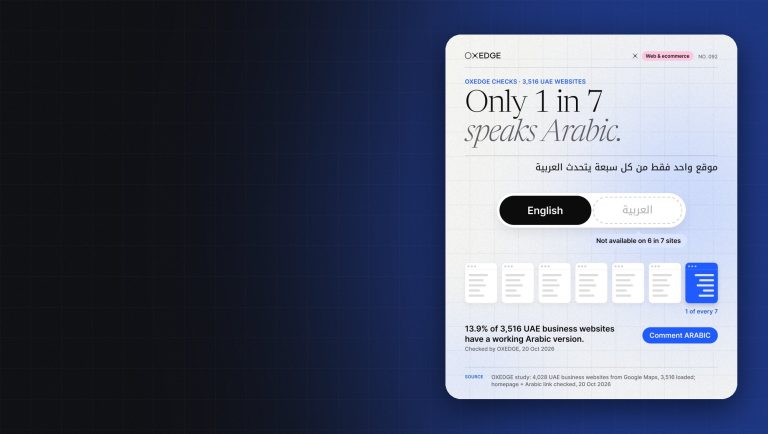
Quick answer: Arabic websites in the UAE are rare: only 13.9 per cent of the 3,516 business homepages we could load on 20 October 2026 offered working Arabic, 11.3 per cent through a linked version and 2.6 per cent with an Arabic or bilingual homepage. 81.5 per cent showed none. Clinics, boutiques and car rental firms did best.
Arabic is the official language of the UAE, so you might expect most local business websites to speak it. We wanted a number rather than a guess. In October 2026 we took every website listed in OXEDGE’s UAE lead lists, 4,028 unique sites from salons and clinics to boutiques and car rental firms, and checked each public homepage with plain HTTP for an Arabic version: language tags, hreflang links, Arabic links and Arabic text. This study reports what we found, by sector and by emirate, how the sites that do offer Arabic build it, and where their Arabic breaks.
Key takeaways
- 488 of 3,516 homepages we could load (13.9 per cent) offered working Arabic; 2,866 (81.5 per cent) had none.
- Boutiques (40.0 per cent) and medical and aesthetic clinics (24.2 per cent) led; dance and martial arts schools (4.7 per cent) and vape shops (4.9 per cent) trailed.
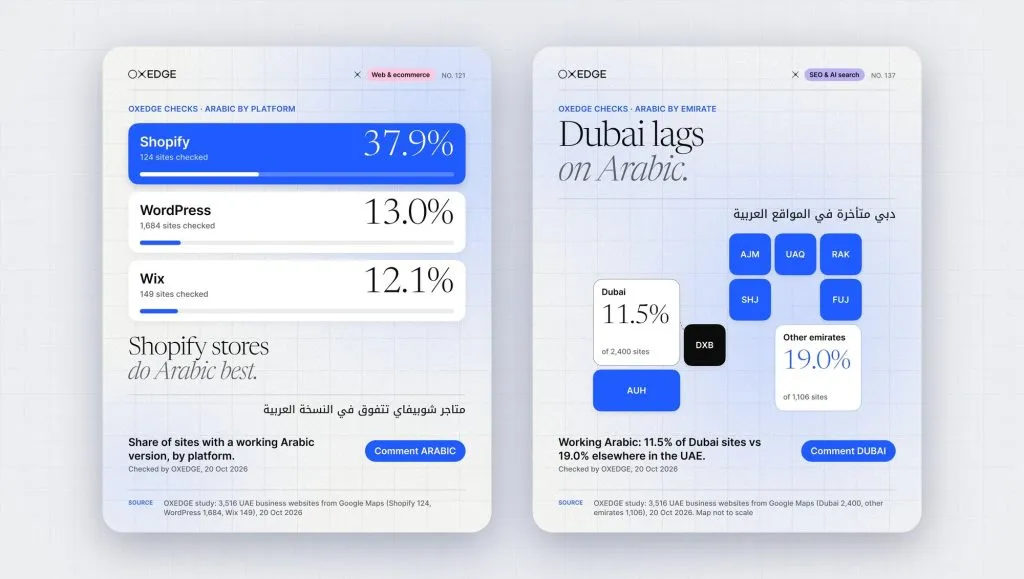
- Sites outside Dubai offered Arabic at 19.0 per cent, against 11.5 per cent in Dubai.
- One in five linked Arabic versions lacked an Arabic hreflang tag, and 135 more sites had Arabic that failed: a broken link or only a widget.
Sources: OXEDGE study of 4,028 UAE business websites, 20 October 2026 (method and data below) · W3Techs, usage statistics of content languages for websites, 20 October 2026
How we checked 4,028 UAE business websites
The sample is every business website in the lead lists OXEDGE keeps for its own outreach, not a hand-picked set. Every number here comes from one script run on one day.
How we did this: We took every website link in two sets of OXEDGE lead lists: Google Maps results from 955 searches on 16 October 2026 (gyms, salons, spas, clinics, dance and martial arts schools and laundries in all seven emirates) and category lists of home services, boutiques, vape shops, salons and car rental firms built from 29 September to 1 October 2026. Of 10,719 listings with a website, we removed 5,449 duplicates and 1,242 links to social, booking, marketplace or public-sector pages, leaving 4,028 unique websites. On 20 October 2026 a Python script fetched each homepage with plain HTTP (desktop Chrome user agent, English language preference, four requests at a time, 15-second timeout) and read the lang and dir attributes, hreflang links, Arabic links and the share of Arabic letters in the text, then fetched any linked Arabic page once to confirm it was Arabic. We count a site as offering Arabic if its homepage is Arabic or bilingual (at least 20 per cent Arabic letters) or its linked Arabic page loads and is in Arabic. Emirates come from the Maps address, the search area or the lead list. “Loaded” means HTTP 200 with HTML. We report aggregates only.
Two limits matter. The lists lean towards consumer services found on Google Maps, so this is a study of small and mid-sized service businesses, not banks or government. And 321 homepages built in JavaScript returned almost no text to plain HTTP; we read their tags and links, but some may show Arabic in a browser. Treat the headline as a floor. The full data is in arabic-website-uae-study-data.csv, one row per site with the website address removed.
Arabic websites in the UAE: fewer than one in seven sites offer Arabic
Of the 3,516 homepages that loaded, 488 offered Arabic that worked. Most used an English homepage linking to an Arabic version, usually under /ar/; a few led with Arabic or mixed both languages on one page.
Per cent of 3,516 homepages that loaded. Hover or tap a bar. Source: OXEDGE study, 20 October 2026, data.
The 81.5 per cent with no Arabic is a strict group: no Arabic text worth counting, no Arabic link, no Arabic hreflang tag and no translation widget. For a visitor who prefers Arabic, there is nothing to click.
The 81.5 per cent with no Arabic is a strict group: no Arabic text worth counting, no Arabic link, no Arabic hreflang tag and no translation widget.
Another 512 listed websites, 12.7 per cent, did not load. In 282 cases the domain no longer resolved, usually because it expired or was never set up. Those links still sit on business listings, so a customer who taps “Website” reaches an error page.
Arabic by sector: clinics and boutiques lead, salons and gyms trail
The spread between sectors is wide. Boutiques and fashion sellers were the most likely to offer Arabic, at 40.0 per cent. Medical and aesthetic clinics (24.2 per cent), car rental firms (21.7 per cent) and dental clinics (21.2 per cent) followed. Fewer than one in ten salons, gyms, laundries, home service firms, vape shops and dance or martial arts schools did.
Per cent of homepages that loaded in each sector. Source: OXEDGE study, 20 October 2026.
| Sector | Homepages loaded | Offer Arabic | Listed sites that did not load |
|---|---|---|---|
| Boutiques and fashion | 155 | 62 (40.0%) | 4.9% |
| Medical and aesthetic clinics | 466 | 113 (24.2%) | 8.8% |
| Car rental | 83 | 18 (21.7%) | 2.4% |
| Dental clinics | 532 | 113 (21.2%) | 8.9% |
| Spas and massage | 321 | 45 (14.0%) | 13.9% |
| Salons and barbers | 637 | 49 (7.7%) | 16.0% |
| Gyms and fitness | 593 | 45 (7.6%) | 15.2% |
| Laundries | 162 | 10 (6.2%) | 16.1% |
| Home services | 192 | 11 (5.7%) | 9.0% |
| Vape shops | 61 | 3 (4.9%) | 29.1% |
| Dance and martial arts schools | 234 | 11 (4.7%) | 13.7% |
“Other services” (80 homepages, 10.0 per cent) is left out of the table. Source: OXEDGE study, 20 October 2026.
Platform tracks the same split. Shopify sites in the sample offered Arabic at 37.9 per cent of 124, against 13.0 per cent of 1,684 WordPress sites and 12.1 per cent of 149 Wix sites. The data shows the pattern, not the reason, but the lesson for a salon, gym or laundry is plain: a working Arabic version would put you ahead of more than nine in ten sites we checked in your sector.
Arabic by emirate: Dubai has the lowest share
Dubai had the lowest share of any emirate: 11.5 per cent of 2,400 homepages, against 19.0 per cent of 1,106 across the other six. The gap holds inside sectors: dental clinics outside Dubai offered Arabic at 30.6 per cent against 14.9 per cent in Dubai, and medical and aesthetic clinics at 34.7 per cent against 18.4 per cent.
How the sites that offer Arabic build it
The 397 sites with a linked Arabic version mostly follow Google’s advice: a different URL for each language, not cookies or browser settings, and hreflang tags in which each version lists itself and every other version. Google detects a page’s language from its content, not from hreflang or the lang attribute.
Sources: Google Search Central, managing multi-regional and multilingual sites · Google Search Central, tell Google about localised versions of your page
| Signal | Sites | Share |
|---|---|---|
| Arabic under /ar/ or a variant such as /ar-ae/ or /arabic/ | 363 of 397 | 91.4% |
| Arabic hreflang on homepage | 317 of 397 | 79.8% |
| Visible Arabic link on homepage | 314 of 397 | 79.1% |
| Arabic page declares lang=”ar” | 336 of 397 | 84.6% |
| Arabic page sets dir=”rtl” | 272 of 397 | 68.5% |
| Arabic via ?lang=ar parameter | 12 of 397 | 3.0% |
| Arabic on an ar. subdomain | 3 of 397 | 0.8% |
Sites with a linked Arabic page that loaded and was in Arabic. Source: OXEDGE study, 20 October 2026.
The /ar/ folder is close to universal: 91.4 per cent of Arabic versions sit under it or a variant such as /ar-ae/. WordPress ran 219 of the 488 sites offering Arabic, and on those the multilingual plugins we detected most often were WPML (65 sites), Polylang (59) and TranslatePress (34).
The direction attribute is weaker. W3C advises dir=”rtl” on the html element whenever a whole document reads right to left, rather than setting direction with CSS alone. Almost a third of the Arabic pages we fetched did not set it on the html element.
Source: W3C Internationalization, structural markup and right-to-left text in HTML
Where Arabic versions break
On top of the 488 sites that passed, 135 showed an Arabic signal that did not hold up. Fifty-seven homepages linked to an Arabic page that failed: 18 of those links returned a 404 error, and 32 loaded a page whose HTML contained no Arabic, either an English copy or a page that builds its text in the browser. Seventy-eight sites had only a translation widget, usually GTranslate (57 sites) or Google’s translate element (17), with no Arabic page of their own.
Widgets look like a cheap fix, but Google’s spam policies list scraped content run through automated translation to mass-produce low-value pages under scaled content abuse, and Google warns that translating only a page’s boilerplate makes a poor experience. A widget is a reading aid, not an Arabic website.
Sources: Google Search Central, spam policies, scaled content abuse · Google Search Central, managing multilingual sites
The Arabic-first sites had their own gap. Of 71 homepages written mainly in Arabic, 22 did not declare lang=”ar”, so screen readers and browsers may read them as the wrong language. And one in five sites with a linked Arabic version had no Arabic hreflang tag on the homepage, which leaves Google to pair the two versions on its own.
None of this is hard to fix. The failures we saw share one trait: nobody checked the English and Arabic pairs end to end. A bilingual site designed for both directions from the start avoids most of it, and our guide to twelve things that break in Arabic-first UX covers the layout side.
The failures we saw share one trait: nobody checked the English and Arabic pairs end to end.
How OXEDGE does this
We build Arabic and English as one site, then test every language pair the way this study did.
- An audit of your lang and dir attributes, hreflang pairs, language switch and Arabic URLs.
- Arabic templates designed right to left from the first wireframe, with copy written or edited by a native Arabic writer.
- One URL per language under /ar/, paired hreflang tags and sitemaps for both versions.
- A launch check that fetches every Arabic page and flags broken links and missing tags.
Why the gap matters: the law, Google and customers
For most service businesses Arabic is a commercial choice; for online sellers it can be a legal one.
The rules: Arabic is the official language of the UAE. Federal Law No. 15 of 2020 on Consumer Protection requires most information given to consumers, including invoices, product information, advertisements and contract and warranty terms, to be in Arabic, with other languages allowed alongside. Its executive regulation, Cabinet Decision No. 66 of 2023, was issued on 3 July 2023 and took effect on 14 October 2023; Pinsent Masons summarises it as requiring data, advertising, contracts, information on websites displayed by e-commerce providers and all invoices to be in Arabic.
Sources: u.ae fact sheet, official language · CMS, the UAE’s new consumer protection landscape · Pinsent Masons, 6 October 2023
This is general guidance, not legal advice; confirm your obligations with a UAE lawyer.
The commercial case is simpler. DataReportal counts 11.3 million internet users in the UAE at the end of 2025, a penetration of 99.0 per cent, yet W3Techs finds Arabic in only 0.6 per cent of website content worldwide. Arabic pages are scarce on the web as a whole, and in our sample fewer than one in seven local service sites had one, so a business with a proper Arabic version has less competition in that language.
Sources: DataReportal, Digital 2026: the United Arab Emirates · W3Techs, content languages, 20 October 2026
Check your own site in five minutes
You can run our checks with a browser and “view source”. Open your homepage, then your Arabic homepage, and look for each item below. For examples of our builds, see our case studies.
| Check | What good looks like | How to test it |
|---|---|---|
| Arabic page exists | A real Arabic page under /ar/ that loads | Click your language switch; the page should be in Arabic, not an error |
| Language attribute | lang=”ar” on the Arabic page, lang=”en” on the English one | View source and read the html tag on the first lines |
| Text direction | dir=”rtl” on the html tag of every Arabic page | Same html tag; the attribute sits next to lang |
| Hreflang pairs | Both pages list themselves and each other | Search the source for “hreflang” on each page |
| Visible switch | A link reading العربية on every English page | Check the header and the phone menu |
| Human Arabic | Copy written or edited by a native speaker | Ask an Arabic-speaking customer to read the main service page |
If your site fails the first check, start with your top three service pages and your contact page in Arabic, link them properly, then extend.
Questions UAE buyers ask
How many UAE business websites have an Arabic version?
In our October 2026 study, 13.9 per cent of 3,516 UAE small and mid-sized business homepages offered working Arabic: 19.0 per cent outside Dubai and 11.5 per cent in Dubai.
Is Arabic required on a UAE business website?
For businesses selling to consumers online, the consumer protection rules require Arabic for website information, advertising, contracts and invoices, with other languages allowed alongside. For other businesses it is a commercial choice. This is general guidance, not legal advice.
Is a Google Translate widget enough?
No. A widget shows a machine translation in the browser, but you have no Arabic pages for Google to index and no control over the wording.
Does hreflang matter if both languages target the UAE?
Yes. Hreflang tells Google the English and Arabic pages are versions of each other, so it can show each searcher the right one. In our study one in five Arabic versions lacked the tag on the homepage.
Can I get my own site checked against the study?
Yes. Send us your website and we will run the study’s checks and send you your score with the fixes in order.
Work with OXEDGE
Get the full study and your own Arabic score.
Send us your website and we will run this study’s checks on it: language tags, hreflang pairs, the Arabic switch and whether your Arabic pages load. You get the full study data and your score, with fixes in order of impact.