



Quick answer: ChatGPT for UAE businesses is safe for company data only on a company workspace, not personal accounts. On Free, Go, Plus and Pro plans the account belongs to the employee and content is used for training unless they opt out. ChatGPT Business costs AED 73 per user per month billed annually; only Enterprise and Edu offer UAE data residency.
Your staff are already using ChatGPT. The real question for an owner is whether they are pasting customer names, salary sheets or contract terms into personal accounts your company does not control, and what that means under UAE data-protection law. This guide answers it plainly: what the free and paid plans do with your data, what each costs, what the federal PDPL and the DIFC and ADGM regimes expect, which data can stay in the UAE today, a traffic-light rule for what staff may paste, how to write an AI policy people follow, and the three assistants worth building before you buy more seats.
Sources: Microsoft AI Diffusion Report Q1 2026, via Khaleej Times · OpenAI, ChatGPT pricing (AED, viewed 7 October 2026) · OpenAI, enterprise privacy · OpenAI Help Center, data residency and inference residency
Watch it on its own page, with chapters and the transcript
Personal accounts versus a company workspace
The real difference between ChatGPT plans is who owns the account and what happens to what is typed into it. On the individual plans (Free, Go, Plus and Pro) the account belongs to the employee, and OpenAI’s pricing page states that content is used to train its models, with an opt-out available. The opt-out is a setting called Improve the model for everyone. Temporary chats are not used for training but may be kept for up to 30 days for safety purposes.
On ChatGPT Business and Enterprise the account belongs to the company. OpenAI commits that business data is not used for training by default, that you own your inputs and outputs where the law allows, and that deleted conversations leave its systems within 30 days unless the law requires longer. One detail belongs in your policy: on Business, workspace admins can view, export and delete members’ conversations. Staff should know that before they start.
Sources: OpenAI Help Center, data controls in ChatGPT · OpenAI, enterprise privacy FAQ
| Plan | Listed price | Training on your content | Retention | Admin and sign-in | UAE residency |
|---|---|---|---|---|---|
| ChatGPT Free and Go | AED 0 and AED 30 per month | Yes, unless the user opts out | Kept in history until the user deletes it | Personal account; no admin | No |
| ChatGPT Plus and Pro | AED 80 per month; Pro from AED 385 | Yes, unless the user opts out | Kept in history until the user deletes it | Personal account; no admin | No |
| ChatGPT Business | AED 73 per user per month billed annually, AED 92 monthly; two users minimum | No, by default | Admins set it; deleted chats removed within 30 days | Admin console, SAML SSO and MFA; no SCIM or role-based access | No |
| ChatGPT Enterprise | Custom pricing through sales | No, by default | Admins set custom retention; deleted chats removed within 30 days | SCIM, key management, role-based access, compliance API, IP allowlisting | Yes, for new workspaces, at no extra cost |
| Microsoft 365 Copilot Business | USD 21 per user per month on annual billing (USD 18 promotional, first year, July to December 2026); needs a Microsoft 365 Business plan | Prompts and responses not used to train foundation models | Your Microsoft 365 retention policies apply | Your Entra ID identities, permissions, sensitivity labels and audit | In-country processing announced for qualified UAE organisations |
| Gemini in Google Workspace | Included in Workspace Business plans; full Gemini in Docs, Drive and Meet from Business Standard | Not used for model training outside your domain without permission | Your Workspace settings apply | Workspace admin console | Data regions on Enterprise plans |
Sources: OpenAI, ChatGPT pricing and plan comparison · OpenAI, enterprise privacy · Microsoft, Copilot business pricing · Microsoft Learn, enterprise data protection in Copilot · Google Workspace pricing · Google, generative AI in Workspace privacy hub. Prices as listed on 7 October 2026.

For a business the takeaway is simple. A Plus subscription paid on a company card is still a personal account: no admin console, no single sign-on, and when the employee leaves, the history leaves with them. Business is the lowest ChatGPT tier where the company holds the keys, and Enterprise is the only one that can keep data in the UAE.
A Plus subscription paid on a company card is still a personal account: no admin console, no single sign-on, and when the employee leaves, the history leaves with them.
What UAE data-protection law says about pasting data into AI
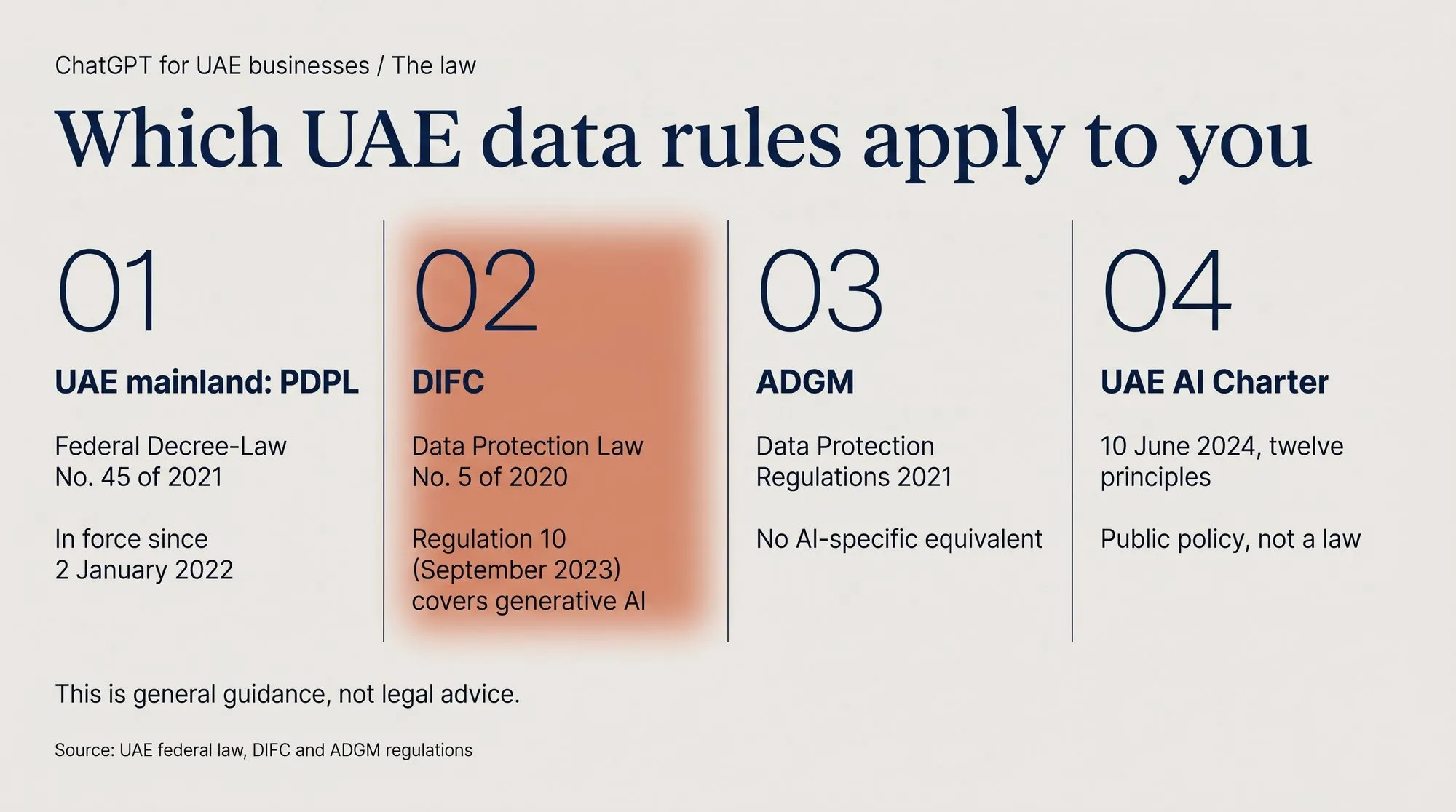
Start with which law applies. Federal Decree-Law No. 45 of 2021 on the Protection of Personal Data (the PDPL), in force since 2 January 2022, covers mainland companies and anyone processing the personal data of people in the UAE. Article 2 excludes government data, health and banking data that have their own legislation, and companies in free zones with their own data-protection law, which in practice means the DIFC and ADGM.
When an employee pastes a customer’s details into ChatGPT, your company is the controller and the AI vendor processes the data for you. Article 8 expects a processor to act on the controller’s instructions under a contract that sets out the scope, purpose and type of data. OpenAI offers a Data Processing Addendum for Business, Enterprise and its API; a personal Plus account has no such contract with your company. That is the legal core of the problem, more than model training.
Articles 22 and 23 cover sending personal data abroad: to countries with adequate data-protection law approved by the UAE Data Office, or otherwise under a contract that imposes the PDPL’s protections, with the person’s explicit consent, or in a few other listed cases. For most AI tools a vendor contract is the realistic route, another reason personal accounts fail.
Sources: UAE Legislation, Federal Decree-Law No. 45 of 2021 · u.ae, data protection laws · OpenAI, Data Processing Addendum availability
What is still open is detail. Article 28 required executive regulations within six months, and Article 29 gives businesses six months to comply once they are issued. The official legislation portal still shows the law as last updated in September 2021, and a Chambers review in March 2026 reported that the regulations had not been issued, with the TDRA acting as the point of contact for data-protection queries. Our PDPL guide for product teams covers the wider obligations.
Sources: UAE Legislation, Articles 28 and 29 · Chambers, Data Protection and Privacy 2026: UAE
Free-zone companies have more specific rules. The DIFC’s Data Protection Law No. 5 of 2020 is supplemented by Regulation 10, enacted in September 2023, which covers personal data processed through autonomous and semi-autonomous systems, including generative AI. It expects people to be told when such systems process their data, with enough information to judge the risk, and high-risk processing to be assessed and documented first. ADGM’s Data Protection Regulations 2021 have no AI-specific equivalent; AI use falls under the existing duties, starting with registering as a data controller.
Sources: DIFC, amended Data Protection Regulations · Clyde & Co, Regulation 10 · ADGM, Data Protection Regulations 2021 · ADGM Office of Data Protection
Across the country, the UAE Charter for the Development and Use of Artificial Intelligence, issued on 10 June 2024, sets twelve principles including data privacy, transparency and human oversight. It is published as a public policy rather than a law, but it signals what regulators and large clients will expect of you. This section is general guidance, not legal advice; take advice for your entity, free zone and sector.
Source: UAE Legislation, UAE Charter for the Development and Use of AI
Keeping data in the UAE: residency options available today

ChatGPT Enterprise and Edu support data residency in ten regions, including the United Arab Emirates, at no extra cost for new workspaces. Conversations, files, custom GPTs, memory and image inputs are stored at rest in the region, with their backups. Workspace metadata, billing details, user logins and anything sent to external apps or web search can sit outside it. ChatGPT Business has no residency option.
Storage is half the story, so OpenAI also offers UAE inference residency to eligible Enterprise and Edu workspaces, meaning model processing on GPUs happens in the country. The trade-offs are real: today only GPT-5.5 and GPT-5.6 Luna run that way, image generation and ChatGPT Work are not supported, and routing and authentication can still happen elsewhere.
Source: OpenAI Help Center, data residency and inference residency for ChatGPT
Microsoft announced in October 2025 that it would offer in-country processing of Microsoft 365 Copilot interactions for qualified UAE organisations from early 2026, hosted in its Dubai and Abu Dhabi data centres. Confirm that your tenant qualifies before relying on it.
Sources: Zawya, Microsoft announcement · Microsoft, in-country data processing for Copilot
For anything you build yourself, the Azure deployment type decides where prompts are processed. Global deployments may process data in any Azure region, and Data Zone deployments cover only the US, EU and Asia Pacific zones. Standard and Regional Provisioned deployments keep prompts and responses within the Azure geography you choose, and data at rest stays in that geography for every type. Geography-based options reach new models last, so confirm availability in a UAE region before designing around a model. Our guide to cloud data residency in the UAE goes further.
Source: Microsoft Learn, deployment types in Microsoft Foundry Models
A traffic light for what staff can paste
Policies fail when staff must judge legal categories in the moment. A colour code with examples from your own business works better.
| Category | Examples | Where it can go |
|---|---|---|
| Green: public material | Published web copy, brochures, public tenders, general research questions, code with no secrets | Any approved company account |
| Amber: internal, no names | Internal procedures, draft proposals, pricing models, contracts with names and figures removed | Company workspace only (Business, Enterprise, Copilot or Gemini under your admin) |
| Red: personal data | Customer lists, CVs and HR records, salaries, Emirates ID or passport numbers, chat exports with phone numbers | Only tools with a processing contract and an approved purpose; never personal accounts |
| Red: regulated or secret | Patient information, banking and card data, client material under NDA, passwords and API keys | Not in chat tools; only systems built and approved for that data |

Two habits sit on top of the table. Strip names, phone numbers and ID numbers before asking for help: most drafting works as well on “the client” as on a real name. And treat credentials as never pasteable, because a password in a chat log is a key to a system, not data to analyse.
How OXEDGE does this
We move UAE teams from personal AI accounts to governed company tools, then build the first assistant on their own data.
- A two-week audit of which AI tools staff use today, what data goes in, and which regime applies to you.
- Workspace set-up with single sign-on, retention and connector settings, plus a two-page bilingual AI policy and traffic-light card.
- A first internal assistant on your documents, hosted where your residency needs require, with an evaluation set agreed before launch.
- A handover runbook so your own admin can manage users, settings and reviews.
Writing an AI use policy staff will follow
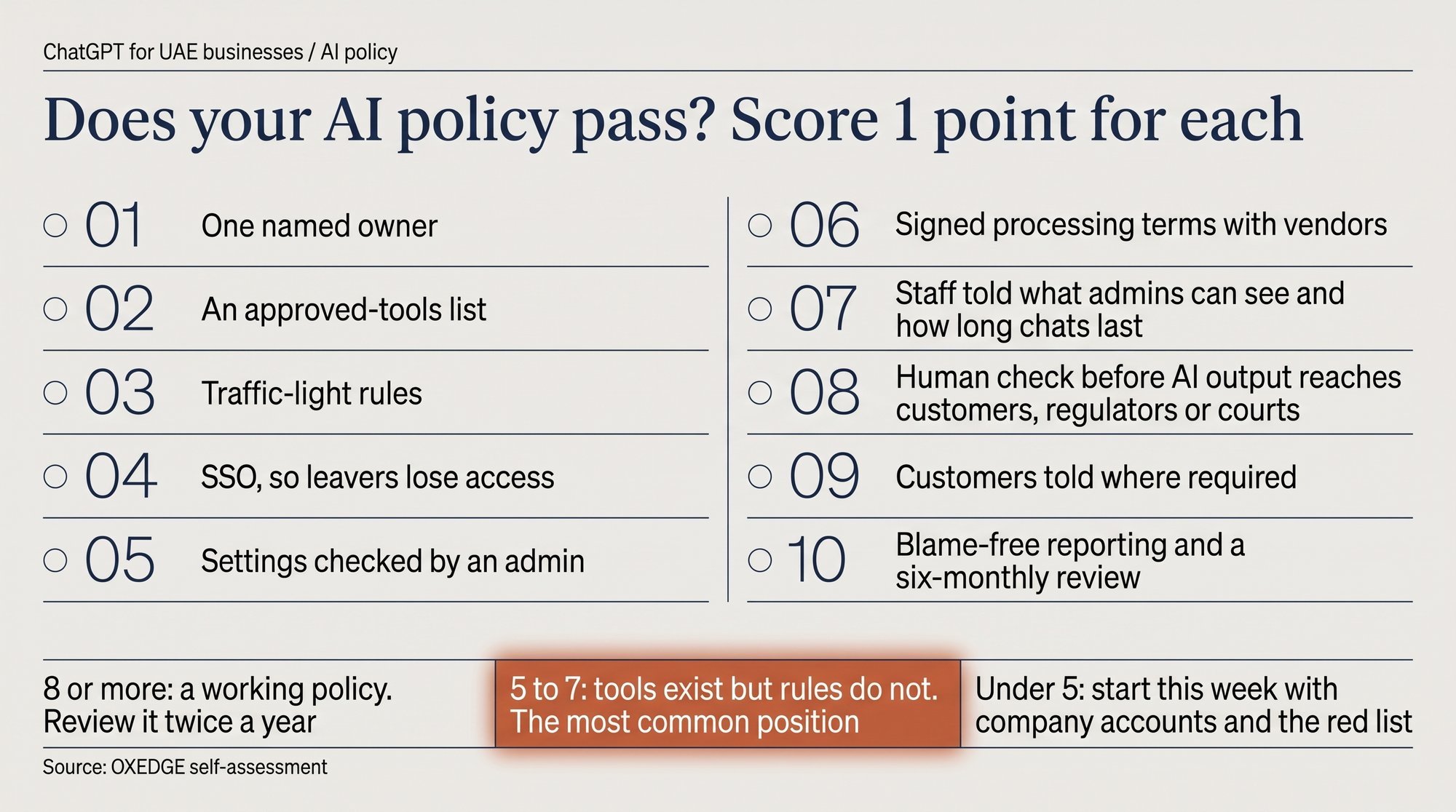
A good policy is short enough to read in five minutes and specific enough to settle arguments. It names the approved tools, the traffic-light rules, who checks AI output before it leaves the company, and who to tell when something goes wrong. Tick what your company already has.
A good policy is short enough to read in five minutes and specific enough to settle arguments.
0 of 10
- One named owner for AI use, and a policy that fits on two pages
- An approved-tools list, with personal AI accounts ruled out for company data
- Green, amber and red data rules with examples from our own work
- A company workspace with single sign-on, so leavers lose access on their last day
- Training, retention and connector settings checked and recorded by an admin
- Signed data processing terms with every AI vendor that sees personal data
- Staff told what admins can see and how long chats are kept
- A rule that a person checks AI output before it reaches customers, regulators or courts
- Customers told when AI drafts or handles their messages, where our regime requires it
- A way to report a wrong paste without blame, and a policy review every six months
Eight or more and you have a working policy; review it twice a year. Five to seven usually means the tools exist but the rules do not, the most common position we see. Under five, start this week with company accounts and the red list.
Three things worth building first
Seats give everyone a general assistant; building gives one workflow a reliable one, connected to your data and bound by your rules. These three pay back fastest, and none needs a large project.
1. An internal assistant on your own documents
Policies, price lists, procedures and past proposals, searchable in plain language, with every answer citing its source. ChatGPT Business already includes company knowledge and connectors to tools such as Microsoft 365 and Google Drive, which is often enough for a first version. Build your own when answers must be restricted by role, documents must stay in a UAE region, or the assistant needs to live inside your intranet or CRM.
Source: OpenAI, ChatGPT Business features
2. Drafting and translation in Arabic and English
Contract summaries, tenders, HR letters and website copy, all needed in two languages. The value is not one-click translation; it is a consistent glossary, your tone of voice and a native Arabic reviewer in the loop for anything published or signed. A small internal tool holding your terminology and templates beats every employee prompting from scratch.
3. Customer replies drafted by AI, approved by a person
The assistant reads the incoming email or message, checks the order or booking record, and drafts a reply that an agent edits and sends. Nothing reaches the customer without a person approving it, which fits the human oversight principle in the UAE AI Charter and, for DIFC firms, Regulation 10’s transparency expectations. When drafts are approved unchanged for weeks, automate the simplest cases; our guide to where AI agents pay off sizes that next step.
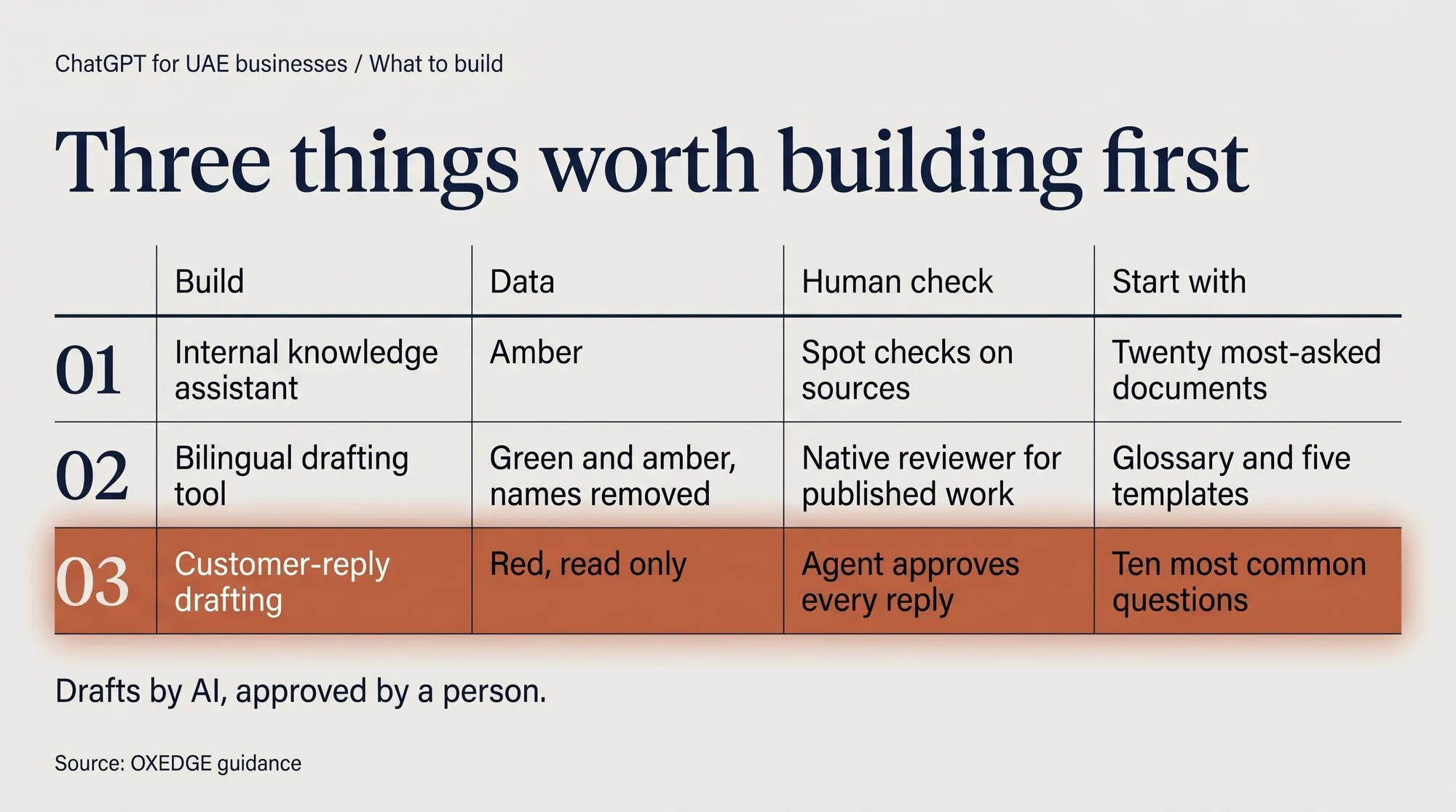
| Build | Data it touches | Human check | Start with |
|---|---|---|---|
| Internal knowledge assistant | Amber: internal documents | Spot checks on cited sources | The twenty documents staff ask about most |
| Bilingual drafting tool | Green and amber, names removed | Native reviewer for anything published | A glossary and five templates |
| Customer-reply drafting | Red: customer records, read only | An agent approves every reply | The ten most common questions |
ChatGPT for UAE businesses: buying seats versus building an assistant
Seats are the right first move for general productivity. Twenty staff on ChatGPT Business billed annually cost AED 1,460 a month, or AED 17,520 a year, at the listed rate, and you get admin control and no training on your data from day one. Seats do not give you control over where one workflow’s data goes, role-based access or integration with your customer systems.
Calculated from OpenAI’s listed ChatGPT Business price of AED 73 per user per month, billed annually.
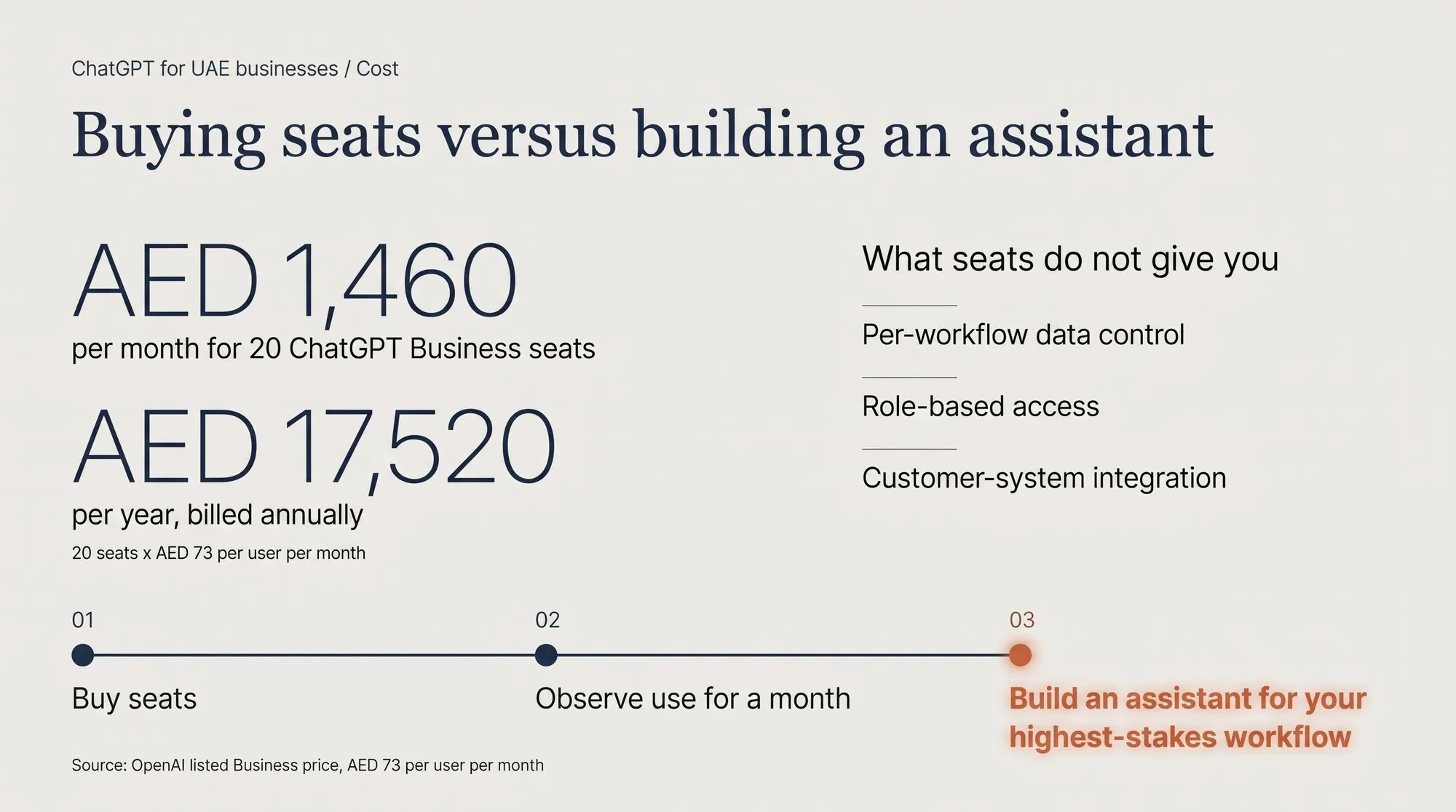
Most companies end up with both. Buy seats first, watch for a month what people use them for, then build an assistant for the workflow where accuracy, residency or integration matters most. For build budgets, see our breakdown of what an AI chatbot costs in the UAE.
A separate question is whether ChatGPT recommends your business when customers ask it who to hire. That is the job of AEO and GEO, and our guide to getting named in AI answers explains how it works.
FAQ: ChatGPT for UAE businesses
Is it safe for staff to use free ChatGPT accounts for work?
Not for company data. On the Free, Go, Plus and Pro plans the account belongs to the employee, and content is used to train OpenAI’s models unless the user opts out. There is no admin console, and a personal account has no processing contract with your company, which is the core problem under the PDPL.
How much does ChatGPT Business cost in the UAE?
OpenAI lists ChatGPT Business at AED 73 per user per month billed annually, or AED 92 billed monthly, with a minimum of two users. Twenty staff on annual billing cost AED 1,460 a month, or AED 17,520 a year. These prices were as listed on 7 October 2026, so confirm them before you buy.
Can ChatGPT keep our company data inside the UAE?
Only on Enterprise and Edu. They support data residency in ten regions including the UAE, at no extra cost for new workspaces, and eligible workspaces can add UAE inference residency. ChatGPT Business has no residency option. Some data, such as workspace metadata, billing details and user logins, can still sit outside the region.
Does a DIFC company have extra rules for using generative AI?
Yes. The DIFC’s Regulation 10, enacted in September 2023, covers personal data processed through autonomous and semi-autonomous systems, including generative AI. People must be told when such systems process their data, and high-risk processing must be assessed and documented first. ADGM has no AI-specific equivalent. This is general guidance, not legal advice.
Work with OXEDGE
Get your team off personal AI accounts and onto tools your company controls.
We would start by mapping which AI tools your staff use, what data goes into them and which UAE regime applies to you. You leave the first conversation with a recommended plan, a draft traffic-light policy and the one assistant worth building first.