


Ten years ago, online shopping in the UAE meant a marketplace, a courier and cash at the door. Today it means a fifteen-minute grocery run from a dark store, a purchase made inside a TikTok video, a checkout split into four instalments, and a product found by asking an AI assistant rather than typing into a search box. The market has not just grown; it has changed shape. This piece maps that change and what it demands from any brand selling in the Emirates in 2026.
Quick answer: Ecommerce in the UAE is a USD 12.30 billion market in 2026, forecast to reach USD 21.01 billion by 2031. It now spans marketplaces, direct stores, social commerce and quick commerce. Wallets and instalments lead at checkout, smartphones carry 78.67% of transactions, and shoppers increasingly use AI to choose. Winning brands run every channel from one stock and order system.
Sources: Mordor Intelligence, 2026 · Visa survey of 1,000 UAE adults, October 2025
Ecommerce in the UAE keeps compounding
The headline numbers are large and, more importantly, still moving. Mordor Intelligence puts UAE ecommerce revenue at USD 12.30 billion in 2026 and expects USD 21.01 billion by 2031, a compound growth rate of 11.29 per cent. That’s a mature market by regional standards and a fast one by global standards. The composition matters as much as the total: business-to-consumer sales took 67.89 per cent of revenue in 2025, but business-to-business ecommerce is the faster mover, projected to grow at 17.43 per cent a year through 2031 as distributors and wholesalers move ordering online.
Geography is concentrated. Dubai accounted for roughly 60 per cent of the market in 2025, Abu Dhabi is closing the gap, and the northern emirates together generate under 15 per cent of volume. For a brand, that concentration is a gift: two cities, dense and well-mapped, where same-day delivery is economically viable and where most of the country’s spending power lives.
Fashion and apparel remained the largest category at 21.59 per cent of revenue in 2025, while food and beverage is the fastest-growing at 13.16 per cent a year, a direct consequence of the quick-commerce boom covered below.
From two marketplaces to everything-commerce

Sources: TechCrunch · CNBC · Arab News · ResearchAndMarkets Quick Commerce Databook, April 2026 · Gulf News, April 2026
The story of the last decade is the story of channels multiplying. Amazon.ae and noon still anchor the market, and together with Carrefour they’re widely estimated to handle close to half of gross merchandise value. But the growth is happening around them, in four channels that barely existed in 2017.
| Channel | Size and trajectory | Who leads | What it demands from a brand |
|---|---|---|---|
| Marketplaces | The core of the USD 12.30bn market; Amazon.ae, noon and Carrefour hold an estimated 45–50% of GMV | Amazon.ae, noon, Carrefour | Catalogue hygiene, reviews, sponsored placement budget, fast fulfilment |
| Direct-to-consumer | Growing with the shift to owned data and margin; enabled by Shopify, Salla and custom builds | Regional fashion, beauty and F&B brands | A fast Arabic/English storefront, local payments, retention marketing |
| Social commerce | USD 3.21bn in 2024, forecast USD 6.41bn by 2030; 73% of UAE and KSA consumers bought via social in the past year | Instagram, TikTok Shop, Snapchat, WhatsApp | Creator partnerships, shoppable video, in-app checkout, rapid content cycles |
| Quick commerce | USD 1.38bn in 2025, forecast USD 1.86bn by 2029 | Talabat, noon Minutes, Careem, Carrefour | Dark-store range planning, real-time stock, packaging for 15-minute handling |
| B2B ecommerce | Fastest-growing model at 17.43% CAGR to 2031 | Distributors, wholesalers, marketplaces’ business arms | Trade pricing, credit terms, ERP integration, bulk ordering UX |
Sources: Mordor Intelligence · Ken Research · Deloitte Digital Consumer Trends 2025 · Quick Commerce Databook 2026
The practical consequence is that “where should we sell?” no longer has one answer. Most successful UAE brands now run a marketplace presence for reach, a direct store for margin and data, and at least one social channel for discovery. The operational cost of that’s real, which is why the brands winning are the ones that have connected stock, pricing and orders behind a single system rather than running each channel by hand.
USD billions. Hover or tap a bar. Sources: Mordor Intelligence · Ken Research · ResearchAndMarkets BNPL report, November 2025 · Quick Commerce Databook 2026
Payments: from cash at the door to four instalments
Cash on delivery was the UAE’s defining ecommerce habit for a decade, and its retreat is the clearest sign of how far the market has matured. Digital wallets held 43.92 per cent of ecommerce payment value in 2025, and buy-now-pay-later is the fastest-growing method at 13.27 per cent a year through 2031. The BNPL market itself was valued at USD 4.82 billion in 2025, led by Tabby and Tamara, both of which split a purchase into four interest-free instalments over six weeks and have pushed into healthcare, automotive and travel as well as retail.
Cash on delivery was the UAE’s defining ecommerce habit for a decade, and its retreat is the clearest sign of how far the market has matured.
The newer force is account-to-account. Aani, the Central Bank’s instant payment platform, passed 12.5 million users in early 2026 after a sixfold year-on-year increase in transfers; it connects 74 licensed financial institutions and roughly 774,000 merchants are set to accept it. noon payments and NEOPAY launched the first Aani checkout for merchants in late 2025, letting a customer pay from their bank by mobile number or QR code. For merchants that means lower fees than cards and instant settlement, which is why it will spread quickly through the mid-market.
Source: Gulf News, Aani crosses 12.5 million users (10 April 2026)
| Method | Where it stands | Why it matters to conversion |
|---|---|---|
| Digital wallets (Apple Pay, Google Pay, bank wallets) | 43.92% of ecommerce payment value in 2025 | One-tap checkout on mobile, where 78.67% of transactions already happen |
| Buy now, pay later (Tabby, Tamara) | USD 4.82bn market in 2025; fastest-growing method | Raises average order value and conversion on AED 500–5,000 baskets; expected by younger shoppers |
| Cards | Still the default for many, but no longer growing fastest | Needs 3-D Secure done well and saved-card flows to compete with wallets |
| Aani account-to-account | 12.5m users; first merchant checkouts live from late 2025 | Lower fees, instant settlement, no card declines; early adopters gain a cost edge |
| Cash on delivery | Declining year on year | Still needed for some categories and first-time buyers, but should be priced or limited to protect margin |
Sources: Mordor Intelligence · ResearchAndMarkets · Gulf News · TechAfrica News
A checkout built for 2019, with card fields first and cash on delivery as the fallback, now loses to a checkout that leads with a wallet button, offers instalments on the product page, and keeps the whole flow inside one screen on a phone.
Logistics: same-day is the baseline, fifteen minutes is the fight
Because the market is concentrated in Dubai and Abu Dhabi, delivery expectations have moved faster than almost anywhere else. Next-day became same-day; same-day became a delivery window; and for groceries, pharmacy and household essentials, the window is now measured in minutes. The quick-commerce segment was worth USD 1.28 billion in 2024 and USD 1.38 billion in 2025, and is forecast to reach USD 1.86 billion by 2029. Growth has slowed to single digits, which is the sign of a segment moving from land-grab to consolidation: Talabat’s USD 32 million acquisition of InstaShop in February 2025 and the shift of leadership from InstaShop to Carrefour, then Talabat, and now Talabat and noon sharing the lead.
The infrastructure behind it’s unusual. noon Minutes runs compact dark stores for 15-minute delivery; ADNOC Distribution and noon opened delivery hubs inside fuel stations in 2025; Carrefour uses its existing supermarket branches for roughly 60-minute grocery delivery; and in December 2025 Yango and noon began rolling out autonomous delivery robots in Dubai communities, starting with Sobha Hartland. Subscriptions lock the habit in: Talabat Pro at AED 19 a month, noon One and Careem Plus all bundle unlimited free delivery.
For brands outside grocery, the lesson is less about speed and more about reliability and returns. Customers now assume tracking, a delivery slot they chose, and a return that’s collected from the door. A brand that can’t offer those through its own store will lose the sale to a marketplace that can.
Mobile and Arabic-first by default
Smartphones carried 78.67 per cent of ecommerce transactions in 2025 and are the fastest-growing device at 16.24 per cent a year, and Visa found that 67 per cent of UAE consumers made their most recent retail purchase on a phone. Deloitte reports near-universal smartphone use, with 96 per cent of consumers in the UAE and KSA using one daily. The desktop store is now the secondary experience.
Source: Deloitte Digital Consumer Trends 2025 (1 September 2025)
Language is the other default. The UAE’s shoppers are Arabic and English speakers in roughly equal weight, with large Hindi, Urdu, Tagalog and Russian-speaking communities. Arabic support can’t be a translated afterthought: right-to-left layout, Arabic product data, Arabic search synonyms and Arabic customer service all affect conversion.
| Requirement | Minimum in 2026 |
|---|---|
| Speed | Product page usable in under 2.5 seconds on a mid-range Android on 4G; images served in modern formats |
| Language | Full Arabic and English storefront with correct right-to-left layout and Arabic search |
| Checkout | Wallet button first, instalments shown on the product page, guest checkout, saved addresses with map pin |
| Delivery | Slot selection, live tracking, doorstep returns, clear cut-off times per emirate |
| Trust | Visible VAT-inclusive pricing in AED, trade licence and contact details, reviews, WhatsApp support |
| Discovery | Shoppable content on Instagram and TikTok, product feeds synced to Google and Meta, structured data for AI assistants |
AI moves from recommendation to agent
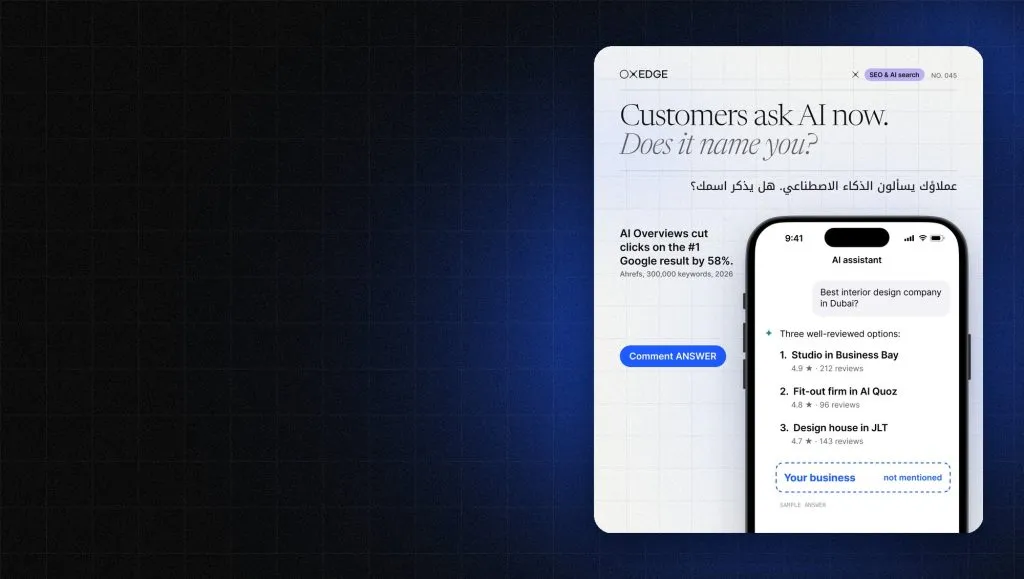
The most striking change of the last eighteen months is how UAE shoppers find things. Visa’s October 2025 survey of 1,000 UAE adults found that 80 per cent use AI to guide shopping decisions and 65 per cent say it inspires product choices, while an Adyen study found 62 per cent open to using AI for the purchase itself. Adyen’s retail study put AI-assisted shopping at 70 per cent of UAE consumers, up 44 per cent in a year. Deloitte found 58 per cent of consumers in the UAE and KSA had used generative AI tools, with 55 per cent of those using them weekly or daily.
Source: Khaleej Times, 8 in 10 UAE shoppers use AI for purchases (9 December 2025)
Two things follow. First, personalisation is no longer a premium feature. Shoppers who ask an assistant for “a gift for a colleague under AED 300” expect the store to respond with relevance, and that relevance has become the strongest predictor of engagement. Second, the next step, agentic commerce, where an assistant completes the purchase, is close but not yet trusted: only around a third of consumers say they would let an AI agent handle checkout on its own. The window is now for retailers to make their catalogues legible to assistants (structured data, clean attributes, honest stock and price feeds) so that when trust arrives, they’re the store the agent chooses.
Privacy is the counterweight. Roughly one in four infrequent AI users cite it as their top concern, so consent, transparency about what is personalised and why, and restraint with data will matter as much as the model behind the recommendation.
What this means for a brand selling in the UAE in 2026
Pulling the threads together: the UAE has become an everything-commerce market. Buyers move between a marketplace, a brand’s own store, a social feed and a quick-commerce app without noticing the seams, and they expect the same prices, stock and service in each. The brands winning aren’t the ones with the most channels but the ones whose channels share one truth. Use the checklist to see where you stand, and read our guide to launching an online store in the UAE if you’re starting out.
The brands winning aren’t the ones with the most channels but the ones whose channels share one truth.
0 of 10
- We sell on at least one marketplace and one owned store, with stock and pricing synced automatically
- Our storefront loads in under 2.5 seconds on a mid-range phone
- Arabic is a full, right-to-left storefront, not a machine-translated layer
- Checkout leads with a wallet button and shows instalments on the product page
- We can offer same-day delivery in Dubai and Abu Dhabi, with slot selection and tracking
- Returns are collected from the customer’s door and refunded within a stated time
- Our product feed is live on Instagram, TikTok, Google and Meta with correct AED pricing
- Product data is structured and complete enough for an AI assistant to recommend us accurately
- We measure repeat purchase rate and act on it with retention campaigns
- We have a plan for Aani or account-to-account payments in the next twelve months
Seven or more and you’re operating at the level the market now expects. Fewer than five and the gap is showing up in your conversion rate, whether or not you can see it in analytics.
The next three years
Three forces will shape the market to 2029. B2B ecommerce will grow faster than consumer retail as distributors digitise ordering. Account-to-account payment will take share from cards as Aani checkouts spread and merchants chase lower fees. And AI assistants will become a discovery channel in their own right, rewarding brands with clean, structured, honest product data. None of these requires a bet on a single platform. All of them require the boring foundation: one product catalogue, one stock position, one customer record, connected to every channel a UAE shopper might be standing in.
That foundation is what OXEDGE builds: storefronts, integrations and automation that let a brand sell in every channel without running five businesses. If you’re planning a launch or a rebuild in the UAE, start a conversation with us.
Frequently asked questions
How big is ecommerce in the UAE?
Mordor Intelligence puts UAE ecommerce revenue at USD 12.30 billion in 2026, growing 11.29% a year to USD 21.01 billion by 2031.
Which payment methods do UAE shoppers prefer online?
Digital wallets hold 43.92% of ecommerce payment value. Buy-now-pay-later is the fastest-growing method, and Aani account-to-account payments are starting to appear at checkout.
Do most UAE shoppers buy on their phones?
Yes. Smartphones carried 78.67% of ecommerce transactions in 2025, so design and test for a mid-range Android first.
Does a UAE online store need Arabic?
Yes. Shoppers are roughly equal Arabic and English speakers, and right-to-left layout, Arabic product data and Arabic search all affect conversion.
What delivery do UAE customers expect?
Same-day is the baseline in Dubai and Abu Dhabi, with a chosen delivery slot, live tracking and doorstep returns. For groceries the window is measured in minutes.
How are UAE shoppers using AI?
Visa’s October 2025 survey found 80% use AI to guide shopping decisions. Agentic commerce, where an assistant completes the purchase, is close but not yet widely trusted.