

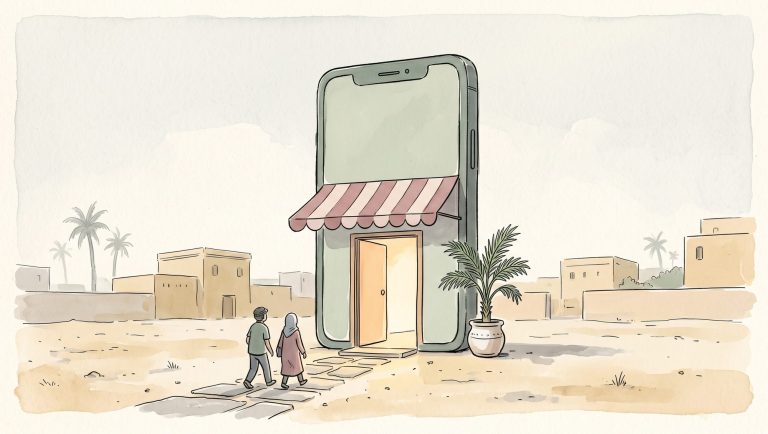


Most guides to “starting an online business in Dubai” are written by licence resellers and stop at the trade licence. That’s the easy part. The store that actually takes money and delivers parcels in the UAE has to get five things right, in order: the legal entity, tax, the storefront, payments, and delivery and returns. Get the order wrong and you end up paying for a licence you don’t need, or launching a shop that can’t legally issue an invoice. This guide walks through each step with the numbers that matter in 2026.
Sources: DED e-Trader cost breakdown · FTA registration thresholds (2026 guide) · Zola UAE VAT registration guide
Quick answer: To launch an online store in the UAE, get five things right in order: the legal entity, VAT, the storefront, payments, and delivery with returns. The cheapest legal route is a DED e-Trader permit at about AED 1,370 a year, VAT registration starts at AED 375,000 of taxable turnover, and a launch usually takes eight to twelve weeks.
Step 1: pick the legal entity that matches how you will sell
The UAE gives you three realistic routes, and the right one depends on who owns the business, whether you need visas, and whether you will sell to companies as well as consumers.
| Route | Who it is for | Typical cost | Watch out for |
|---|---|---|---|
| DED e-Trader permit (Dubai) | UAE and GCC nationals and residents selling as individuals through social media or a small store; no office, no staff | About AED 1,370 a year (AED 1,070 permit plus AED 300 Chamber membership) | No visas, no physical shop, limited activities; you trade under your own name |
| Mainland e-commerce licence (DET) | Companies that want to sell anywhere in the UAE, open physical points later, or sell to government and large corporates | AED 12,000–25,000 for the licence; AED 25,000–40,000 in year one with office lease (Ejari) and a visa | Needs an office address; some activities still need external approvals |
| Free-zone e-commerce licence | Foreign founders wanting 100% ownership with a simple setup; import/export and online-only models | From about AED 5,750 for a zero-visa package; AED 11,000–35,000 with visas | Selling to the mainland may need a distributor or a dual licence; check the zone’s rules before you launch |
Sources: Free zone vs mainland comparison · E-commerce licence cost guide 2026 · QuickPlus 2026 cost guide. Costs move with the authority, the package and the year; treat them as a range and get a written quote.
Two practical notes. First, since the 2021 ownership reforms, foreign nationals can own a mainland company outright for most commercial activities, so the old “free zone for ownership, mainland for access” split is weaker than it was. Second, the licence activity must match what you sell: “e-commerce” as an activity covers a general online store, but regulated categories such as food, cosmetics, supplements, medical devices and electronics with radio components need product registration or external approvals before you list them.
Step 2: register for VAT at the right moment

The UAE charges 5 per cent VAT on most goods and services. Registration with the Federal Tax Authority is mandatory once your taxable supplies and imports pass AED 375,000 in any rolling twelve-month period, and you have 30 days from crossing the line to register or face a fixed AED 10,000 penalty. Voluntary registration opens at AED 187,500, and for a store that buys stock and pays for advertising it’s usually worth registering early so you can recover input VAT and show a Tax Registration Number on your invoices.
Source: MBG, VAT registration threshold in the UAE (15 April 2026)
Non-resident businesses are treated differently: with no UAE establishment, a single taxable sale to a UAE consumer can trigger a registration obligation, which is one reason overseas brands often prefer a local entity rather than shipping cross-border into the market.
Once registered, three things change on the storefront:
- Prices shown to consumers must be VAT-inclusive, in AED.
- Every order needs a tax invoice with your TRN, the VAT amount and the customer details the law requires.
- Your returns process must reverse VAT correctly through credit notes, which most UAE-ready platforms handle if you configure tax properly on day one.
Sources: MBG: VAT registration threshold UAE · EmaraTax registration process 2026
Step 3: comply with the ecommerce law before you write a line of code
Federal Decree-Law No. 14 of 2023 on Trading by Modern Technological Means has applied since September 2023 to anyone selling goods, services or data through websites, apps or social platforms. It’s not a large law, but it sets the checklist your storefront must pass.
Source: Reed Smith, UAE federal law on modern trading by technological means (20 October 2023)
| Obligation | What it means on your site |
|---|---|
| Licensed and identifiable | Display the trade licence number, legal name and a working contact route; keep a complaints channel |
| Full price disclosure before purchase | Show product price, VAT, delivery fees and any payment surcharges before the customer commits |
| Invoice for every sale | Issue a detailed invoice, digital is fine, with the items, amounts and your details |
| Return rights | Customers can return or exchange goods that are defective, incomplete, damaged or not as described; you cannot block that right in your terms |
| Secure digital environment | Meet the competent authority’s security standards; in practice HTTPS everywhere, a PCI-compliant payment gateway, no card data stored on your servers |
| Data protection | Handle customer data under UAE data protection law: a privacy notice, a lawful basis, and no selling of customer data |
Sources: Federal Decree-Law No. 14 of 2023 (Ministry of Economy PDF) · Reed Smith analysis · BDO Legal
The cheapest time to comply is at build. Terms and conditions, a returns policy, a privacy notice and invoice templates written for the UAE cost a few hours from a local lawyer; retrofitting them after a consumer complaint costs far more.
Step 4: choose a storefront platform you can operate
The platform decision is less about features than about who will run the store every day. A three-person team with no developer needs a hosted platform with a UAE payment and shipping ecosystem; a brand with unusual pricing, B2B accounts or an existing ERP needs something it can extend.
The platform decision is less about features than about who will run the store every day.
| Option | Best for | UAE readiness | Trade-off |
|---|---|---|---|
| Shopify | Consumer brands that want to launch fast and run marketing themselves | Strong: local gateways, Tabby and Tamara apps, Arabic themes, courier apps | Monthly fees and app costs add up; deep customisation needs a developer |
| Salla / Zid | Brands selling across the GCC with Saudi as a priority | Built for the region: Arabic-first, local payments and couriers out of the box | Smaller app ecosystem; less flexible for complex catalogues |
| WooCommerce (WordPress) | Content-heavy brands and teams that already run WordPress | Good with the right plugins; you own hosting, security and updates | Performance and maintenance are your problem |
| Custom build (headless or framework) | B2B, marketplaces, subscription models, or anything with real integration needs | As ready as you make it | Highest upfront cost; needs an engineering partner for the life of the store |
Whatever you choose, four requirements are non-negotiable for the UAE: a full Arabic and English storefront with correct right-to-left layout, VAT-inclusive AED pricing, mobile performance (most UAE ecommerce transactions now happen on a smartphone), and a checkout that supports the local payment mix described next.
Step 5: payments the way UAE customers actually pay
You need a licensed payment gateway that settles in AED to a UAE bank account. The main options in 2026, with published entry-level pricing:
| Gateway | Published pricing (entry tier) | Where it fits |
|---|---|---|
| Telr | About AED 99 a month plus 2.49% + AED 0.50 per transaction on the Pro plan; a higher monthly plan lowers the per-transaction rate | The default for UAE SMEs; Dubai-founded, regional support |
| PayTabs | Around 2.85% + AED 0.27 per transaction on Growth; AED 183 a month on Startup with metered fees | Brands expanding to Saudi and the wider GCC |
| Checkout.com | Roughly 2.9% plus a fixed fee at standard tier; interchange plus 0.10–0.40% at enterprise volume | High-volume merchants and international brands |
| Stripe | 2.9% + AED 1 for UAE cards; 3.9% for international cards; no monthly fee | Tech businesses and startups that want the fastest onboarding |
Source: UAE payment gateway comparison 2026. Pricing changes; confirm on a current quote.
Beyond cards, plan for the methods that move conversion in this market: Apple Pay and Google Pay (usually enabled through the gateway), buy-now-pay-later through Tabby or Tamara (separate merchant agreements, typically a higher fee in exchange for larger baskets), and cash on delivery for categories where first-time buyers still expect it. Aani account-to-account payments are starting to appear at checkout through providers such as noon payments and NEOPAY and are worth planning for within the year.
Step 6: delivery and returns in a two-city market
Delivery in the UAE has three quirks a new store must design around. There are no street addresses in the way European systems expect: customers describe a building, an area and a landmark, and every serious courier and platform now supports a map pin or Makani number at checkout. Same-day delivery in Dubai and Abu Dhabi is the expectation for anything in stock, next-day for the rest of the country. And cash-on-delivery orders carry a higher refusal rate than prepaid ones, so many stores add a small COD fee or cap COD order values.
Cash-on-delivery orders carry a higher refusal rate than prepaid ones, so many stores add a small COD fee or cap COD order values.
Practical setup:
- Couriers: integrate at least one national courier through your platform (Aramex and Emirates Post cover the whole country; Quiqup, Fetchr-style and platform couriers handle same-day in the cities) and one backup.
- Cut-off times by emirate: publish them on the product page, not just in the FAQ.
- Returns: the law gives customers a return right for defective or misdescribed goods; competitive stores go further with door collection and a stated refund window. Decide who pays return shipping for change-of-mind returns and say so before checkout.
- Tracking: the courier’s tracking page is fine to start; a branded status page with WhatsApp updates is a measurable improvement later.
The launch checklist
Tick what is already true. Anything unticked is a launch blocker, a legal risk, or a conversion leak.
0 of 10
- Licence issued with an activity that covers everything we sell, and regulated products approved
- Trade licence number, legal name and contact details shown on the site
- VAT position decided: registered with a TRN, or below threshold with a monitoring plan
- Prices shown VAT-inclusive in AED, with delivery and payment fees disclosed before checkout
- Tax invoice issued automatically on every order
- Terms, returns policy and privacy notice written for UAE law
- Full Arabic and English storefront with right-to-left layout tested on a phone
- Gateway live with Apple Pay and Google Pay; BNPL and COD decisions made
- Courier integrated with map-pin addresses and cut-off times per emirate
- Returns collected from the door with a stated refund window
Timeline and budget for an online store in the UAE
A brand that starts from nothing can be trading in eight to twelve weeks if the licence and bank account are started first. Bank account opening is the most common delay, often four to six weeks for a new company, and your payment gateway can’t settle without it.
| Weeks | Workstream | Output |
|---|---|---|
| 1–2 | Entity and licence application; bank account started | Licence issued; account in progress |
| 2–4 | Legal documents; VAT registration if required; product data and photography | T&Cs, returns policy, privacy notice; catalogue ready |
| 3–8 | Storefront build in both languages; gateway and courier integration; tax configuration | Staging store with test orders end to end |
| 8–10 | Test orders, refunds and returns; performance tuning; analytics and pixels | Launch sign-off |
| 10–12 | Soft launch to a small audience; fix what breaks; then paid and social launch | Live store with first real orders |
Budget the store as an operating cost, not a one-off. Licence, hosting or platform fees, gateway fees of roughly 2.5–3 per cent, courier costs, returns handling and marketing recur every month; the build is the smaller number over three years.
Where brands go wrong
Three failures repeat across the launches we have seen. Buying the licence before deciding the model, then discovering the free zone can’t sell to mainland customers without a distributor. Launching English-only “for now” and never fixing it, which quietly halves the addressable market. And treating delivery as the courier’s problem: the customer holds the brand responsible for a late parcel, not the courier, so the store must own tracking, communication and the returns experience.
If you’re planning a UAE launch, OXEDGE builds the storefront, integrations and automation and works with your licensing and legal advisers so the store is compliant on day one. Start a conversation with us.
Frequently asked questions
What are the essential steps to launch an online store in Dubai?
Pick the legal entity, register for VAT at the right moment, comply with the ecommerce law, choose a storefront platform, set up payments and sort delivery and returns. Start the licence and bank account first.
How do I register an ecommerce business in Dubai?
Choose between a DED e-Trader permit, a mainland e-commerce licence or a free-zone licence, depending on who owns the business, whether you need visas and where you will sell.
What are the popular payment gateways for ecommerce websites in Dubai?
Telr, PayTabs, Checkout.com and Stripe are the main options, alongside Apple Pay, Google Pay and buy-now-pay-later through Tabby or Tamara.
When must an online store register for VAT in the UAE?
Registration is mandatory once taxable supplies and imports pass AED 375,000 in any rolling twelve months, and you have 30 days to register. Voluntary registration opens at AED 187,500.
How long does it take to launch an online store in the UAE?
Eight to twelve weeks if the licence and bank account are started first. Bank account opening is the most common delay.
Does a UAE online store need an Arabic version?
Yes. Plan a full Arabic and English storefront with correct right-to-left layout, VAT-inclusive AED prices and a checkout that supports local payment methods.