



Quick answer: The questions to ask an ecommerce agency in the UAE before signing cover ten things: UAE stores launched, platform and ownership, payments and refunds, VAT and the law, Arabic, delivery and returns, SEO and redirects, security and peak traffic, price and contract, and support. Good answers are specific and written; red flags are vague or keep your accounts in the agency’s name.
Most ecommerce agencies in Dubai can show you a beautiful homepage. Fewer can tell you, in writing, how a Tabby refund flows back into stock, whose name the payment gateway account sits in, or what happens to your Google traffic when old product URLs disappear. Those answers decide what a store costs to run and to leave. Here are 30 questions in ten groups, with good and red-flag answers and a checklist you can print.
Key takeaways
- Get answers in writing and score every agency on the same checklist.
- Domain, platform, payment and Google accounts belong in your company’s name.
- Test every payment method before launch, refunds and cancellations included.
- Arabic means checkout, emails and invoices that work right to left.
- Replacing a store without a redirect map risks the search traffic you have.
Sources: EZDubai and Euromonitor International, sixth annual e-commerce report, via Emirates News Agency (29 September 2026) · Visa Acceptance Solutions and PYMNTS Intelligence, 2025 Global Digital Shopping Index, UAE (2 July 2025; 1,679 consumers) · StatCounter Global Stats, UAE platform share, September 2026 · Baymard Institute, cart abandonment rate (updated 22 September 2025)
Start here: the questions to ask an ecommerce agency in the UAE on a 30-minute call
One call per agency? Ask these five; they cover what is hardest to change after you sign. For general agency checks, such as IP clauses, see our guide to choosing a web design agency in Dubai.
- Which UAE stores have you launched recently, and can we call two owners?
- Whose name will the domain, platform, payment gateway and Google accounts be in?
- Which payment methods will checkout offer, and how does a refund work for each?
- Who writes the Arabic, and does checkout work right to left on a phone?
- What is in the fixed price, and what does leaving cost?
UAE experience, platform and who owns what
The hard parts of a UAE store are local: your bank’s gateway, pay-later providers, cash on delivery, couriers, and peaks around Ramadan, White Friday and the Dubai Shopping Festival. Shopify alone counts 27,014 live UAE stores, so recommending it’s common and often sensible, but the reasons should fit your catalogue and team.
Source: Store Leads, Shopify stores in the United Arab Emirates (updated 16 October 2026)
Running costs matter too. For a Shopify store, which paid apps will it rely on? For a WooCommerce store, who updates WordPress, plugins and the server? Our UAE platform comparison covers the trade-offs.
| Topic | Ask this | Good answer | Red flag |
|---|---|---|---|
| UAE stores launched | 1. Which UAE stores have you launched recently, and can we call two owners? | Live stores, and references you call alone | “Our clients are under NDA” |
| Local integrations | 2. Which UAE gateways, pay-later providers and couriers have you connected? | Named providers, and a problem they solved | “We can integrate anything” |
| Peak season plan | 3. How do you prepare for Ramadan, White Friday and DSF? | Change freeze, load tests and on-call cover, agreed early | “We will upgrade the server” |
| Platform choice | 4. Why this platform for us, and when would you suggest another? | Reasons tied to your catalogue, team and integrations | One platform for every client |
| Accounts in your name | 5. Whose name will the domain, platform, payment and Google accounts be in? | Yours; the agency gets its own login | “Easier if we keep them” |
| Code and exit | 6. Who owns the theme and custom code, and what does leaving cost? | Yours on payment, with repository access | A licence, or a handover fee |
Ownership is where most disputes start, because nobody thinks about it until the relationship ends. Accounts held by the agency mean new approvals and lost history when you leave.
Ownership is where most disputes start, because nobody thinks about it until the relationship ends.
Payments, VAT and the law
In Visa’s 2025 study, 77 per cent of UAE shoppers said payment options influence where they shop; in Baymard’s US survey, 40 per cent of checkout abandoners blamed extra costs. Tabby’s docs require testing for every integration with test keys, refunds and cancellations included: ask to see it passed. See our Tabby, Tamara and Apple Pay guide.
Sources: Visa newsroom, UAE leads world in mobile shopping (2 July 2025) · Baymard Institute, reasons for abandonment during checkout (US survey; excludes shoppers just browsing) · Tabby developer docs, testing guidelines
| Topic | Ask this | Good answer | Red flag |
|---|---|---|---|
| Checkout methods | 7. Which payment methods will checkout show on day one? | Cards, Apple Pay, Tabby or Tamara, cash on delivery, chosen for your customers | “Whatever the gateway supports” |
| Refunds and cancellations | 8. How do refunds and pay-later cancellations work, and does stock return? | Each flow tested in the sandbox, stock updated | “The gateway handles it” |
| Payout reconciliation | 9. How will we match payouts, fees and courier cash to orders? | A settlement report by gateway and courier | “Check the bank statement” |
| VAT and invoices | 10. Will prices include VAT, and will orders get Arabic invoices? | VAT-inclusive prices, an Arabic digital invoice per order | English-only invoices |
| Legal pages | 11. Where will we show our licence, terms, returns policy and complaints contact? | Named pages, linked from checkout, reviewed by your lawyer | “A template terms page” |
| Customer data | 12. What data do you collect, where is it hosted, how is it deleted? | A data list, hosting regions and a deletion process | “It is all in the cloud” |
The rules: Federal Decree-Law No. 14 of 2023 on Trading by Modern Technological Means (Ministry of Economy, issued 4 September 2023) requires published prices and fees, a non-paper invoice, a visible licence and a complaints channel (Articles 5 and 6), and sets return rights (Article 7). Federal Law No. 15 of 2020 on Consumer Protection, amended by Federal Decree-Law No. 5 of 2023, requires Arabic invoices and Arabic product information from UAE-registered e-commerce businesses. VAT is 5 per cent, displayed prices must include it (Article 38, Federal Decree-Law No. 8 of 2017), and registration is mandatory at AED 375,000. The PDPL, Federal Decree-Law No. 45 of 2021, has applied since 2 January 2022. This is general guidance, not legal or tax advice.
Sources: Ministry of Economy, Federal Decree-Law No. 14 of 2023, English text, Articles 5, 6, 7 and 21 · u.ae, consumer protection · Habib Al Mulla and Partners via Mondaq, VAT-inclusive displayed prices (8 August 2025) · Federal Tax Authority, VAT registration · u.ae, data protection laws
Selling to businesses too? Under Ministerial Decision No. 244 of 2025, e-invoicing starts on 1 January 2027 for revenue of AED 50 million or more and 1 July 2027 for the rest; consumer sales are exempt until further notice. Confirm dates with the Ministry of Finance. Licensing steps are in our guide to launching an online store in the UAE.
Sources: KPMG TaxNewsFlash, UAE e-invoicing, Ministerial Decisions 243 and 244 of 2025 (October 2025) · u.ae, eCommerce
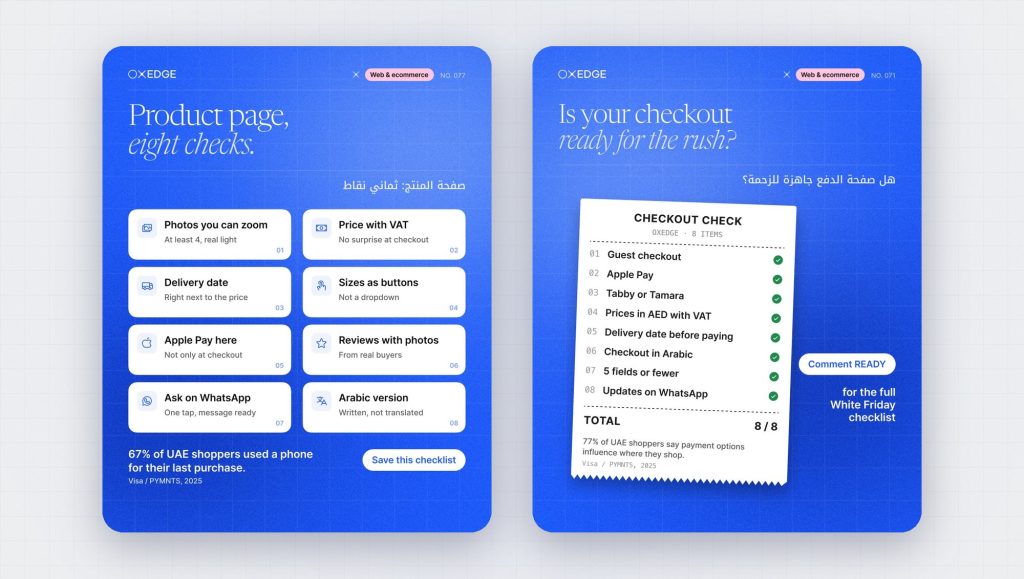
Source for the figures on both cards: Visa Acceptance Solutions and PYMNTS Intelligence, 2025 Global Digital Shopping Index, UAE (2 July 2025)
Arabic, delivery and returns
Product information and invoices must be in Arabic, so Arabic is a checkout question, not only a storefront one. For Google, each language version must list itself and the others in hreflang tags, and tags that don’t point both ways are ignored. Article 14 of the e-commerce law bars logistics fees beyond those announced. See also why customers abandon checkout in the UAE.
Sources: u.ae, consumer protection · Google Search Central, localised versions of your page · Federal Decree-Law No. 14 of 2023, Article 14
| Topic | Ask this | Good answer | Red flag |
|---|---|---|---|
| Arabic authorship | 13. Is the Arabic written or machine translated, and who reviews it? | A native writer, a review step, Arabic product data | “The plugin translates it” |
| Right to left everywhere | 14. Do checkout, emails, invoices and WhatsApp messages work right to left? | A phone test plan for each, in both languages | Only the homepage checked |
| Arabic for Google | 15. How will Google find the Arabic pages? | Separate Arabic URLs with two-way hreflang | Language switched by cookie |
| Couriers and fees | 16. Which couriers, and when does the customer see the fee and date? | Named couriers; fee and date before payment | Fees after card details |
| Stock sync | 17. Where does stock live, and how often does it sync? | One source, such as your ERP or POS, on a set schedule | “Update stock by hand” |
| Returns end to end | 18. How does a return work, from request to refund? | Request, pick-up, inspection, refund, restock | “Customers can email you” |
Search, tracking, security and peak season
Replacing a store? Google advises mapping every old URL to a new one with permanent redirects such as 301, kept for at least a year, and warns of temporary ranking fluctuation; see our guide to protecting rankings in a redesign. GA4 requires a transaction ID for purchases and refunds, and Merchant Center free listings need good product data.
Sources: Google Search Central, site moves with URL changes · Google Analytics, measure ecommerce · Google Merchant Center Help, free listings
PCI DSS applies to anyone handling card data; Stripe notes that taking card numbers directly can mean more than 300 security controls, which hosted payment forms avoid. The e-commerce law adds a secure environment and a continuity plan (Article 5). Google’s Core Web Vitals call a Largest Contentful Paint of 2.5 seconds or less good.
Sources: Stripe, integration security guide · Federal Decree-Law No. 14 of 2023, Article 5 · web.dev, Web Vitals
| Topic | Ask this | Good answer | Red flag |
|---|---|---|---|
| Redirect map | 19. How will every old URL be redirected? | An old-to-new URL map, 301s, checks after launch | “Google will figure it out” |
| GA4 ecommerce | 20. Which GA4 ecommerce events will you set up and check? | Events to purchase and refund, matched to real orders | “Analytics is installed” |
| Merchant Center feed | 21. Will products feed Google Merchant Center? | A complete feed plus product structured data | No Google Shopping plan |
| Card data | 22. Will card details ever touch our servers? | No: a PCI-compliant provider’s hosted form | Custom card fields |
| Backups and recovery | 23. How are backups kept, and when was a restore last tested? | Daily, stored separately, a restore you can watch | “The host does backups” |
| Speed and peak load | 24. What speed targets, and how will you load test before peak? | Mobile Core Web Vitals targets and a load test above normal traffic | “Fast on our Wi-Fi” |
In Baymard’s survey, 17 per cent of checkout abandoners left because the site had errors or crashed. A store that slows down on the first evening of White Friday loses the customers it paid most to attract.
Source: Baymard Institute, reasons for abandonment during checkout (US survey)
A store that slows down on the first evening of White Friday loses the customers it paid most to attract.
How OXEDGE does this
We build UAE online stores so all 30 questions have a written answer before launch.
- Every account opened in your company’s name: domain, platform, gateway, Analytics and Merchant Center.
- Checkout tested on a phone with each payment method, including sandbox refunds and pay-later cancellations.
- Arabic written and reviewed by people; checkout, emails and invoices checked right to left.
- A redirect map for every old URL, and GA4 events checked against real orders.
- A handover runbook and training for orders, refunds, stock and content.
Price, contract, team and support
A low quote with a vague scope grows through change requests, so compare written scopes, not totals.
| Topic | Ask this | Good answer | Red flag |
|---|---|---|---|
| Fixed-price scope | 25. What is in the fixed price, and what is a change request? | Pages, integrations, imports and revisions, in writing | “Everything included” |
| Milestones and payments | 26. What do we approve before each payment? | Payments tied to design, build and launch sign-offs | Most of the fee up front |
| Warranty period | 27. What does the warranty cover, and for how long? | Their own bugs fixed free for an agreed period | “Every change is billable” |
| Who does the work | 28. Who will work on our store, and is any of it subcontracted? | Named people, subcontractors disclosed | Unknown developers later |
| Support after launch | 29. What support do we get, in which hours and languages? | Written response times, peak-period cover | “Message us any time” |
| Training and handover | 30. Will you train our team and hand over documentation? | Recorded training and a runbook | “Just call us” |
Score each agency: the printable checklist
Tick an item only when the answer is clear and in writing. Score each agency separately.
0 of 15
- Live UAE stores shown; two owners called without the agency
- UAE gateways, pay-later providers and couriers named
- Every account in our company’s name
- Code and theme ours on payment, no exit fee
- Refund flow explained for each payment method
- Payouts and courier cash reconciled to orders
- VAT-inclusive prices and Arabic invoices
- Licence, terms, returns and complaints pages in scope
- Arabic written by people, tested right to left
- Delivery fee and date shown before payment
- Redirect map for every old URL, or a new store
- GA4 ecommerce events and Merchant Center feed in scope
- Card data with a PCI-compliant provider; restore shown
- Written scope, milestone payments and a warranty
- Named team, written support terms and training
Thirteen or more: a strong candidate. Nine to twelve: fix the gaps first. Eight or fewer: keep looking.
Red flags that end the conversation
- The domain, platform or gateway account stays in the agency’s name.
- No live UAE store to show, only designs.
- Arabic by translation plugin, with checkout never tested right to left.
- No redirect plan for a store that already ranks.
- Card fields built into your own site.
- A discount that disappears unless you sign this week.
Our work
Unbranded: a WooCommerce teamwear store
OXEDGE designed and built Unbranded’s UK teamwear store in 2023 on WordPress and WooCommerce: kit filters by design, size and colour, product pages with a size guide, and a Quick Quote form.
Questions UAE buyers ask
How many ecommerce agencies should we compare?
Three is usually enough. Send each the same 30 questions and score the written answers on one checklist.
Should we or the agency open the payment gateway account?
Your company. The merchant account receives your sales and pays out to your bank, so it belongs in your name; the agency needs developer access, not ownership.
Do we need Arabic on the store at launch?
The UAE Government portal says UAE-registered e-commerce businesses must give product information and invoices in Arabic. A full Arabic storefront is a commercial choice. This is general guidance, not legal advice.
Source: u.ae, consumer protection
Is recommending Shopify over a custom build a red flag?
No. A hosted platform often suits a new store. The red flag is the same platform for every client.
We already have a store. What should we ask first?
Question 19: the redirect map, before design starts. Building a new UAE online store instead? Start with questions 5 and 7.
How to find reliable ecommerce service providers in the UAE?
Shortlist three agencies with live UAE stores you can look at, then ask to call two of their owners alone. “Our clients are under NDA” is the red flag; named stores and references you can call are the good answer.
Work with OXEDGE
Put all 30 questions to us, and get the answers in writing.
We start with your catalogue, payment methods and current store, and you leave the first conversation with a written scope to compare with any agency’s.