



Quick answer: Checkout abandonment in UAE stores is mostly fixable: late extra costs, a missing preferred payment method, forced accounts, address forms built for postcodes and bank approval time-outs. Baymard puts documented cart abandonment at 70.22 per cent, though much of that’s browsing. Show VAT-inclusive totals early, offer guest checkout and wallets, and track each step in GA4.
Most UAE shoppers who reach your checkout and then leave do so for reasons you can fix: a delivery fee or total that appears too late, a missing payment method such as Apple Pay, Tabby or cash on delivery, a forced account, an address form built for postcodes, or a bank approval step that times out. Globally about seven in ten carts are abandoned, and part of that’s simply browsing. This guide separates the losses you can recover from the ones you can’t, then covers UAE payments, VAT-inclusive pricing, address forms, a checkout audit, GA4 funnel tracking, recovery messages and testing.
Sources: Baymard Institute, cart abandonment rate statistics (updated 22 September 2025) · Visa Acceptance Solutions and PYMNTS Intelligence, 2025 Global Digital Shopping Index, UAE edition (2 July 2025) · Adyen, UAE shopper insights 2025
How much checkout abandonment is normal, and why shoppers leave
Baymard Institute averages 50 studies and puts the documented cart abandonment rate at 70.22 per cent. Much of that was never a sale: in Baymard’s US survey, many abandoners were only browsing. The rest gave reasons a store can act on.
| Reason for leaving | Share of shoppers | How it shows up in a UAE store |
|---|---|---|
| Extra costs too high | 40% | Delivery or cash-on-delivery fee on the last step |
| Delivery too slow | 20% | “3 to 5 working days”, no date |
| Card security doubts | 19% | No company details; odd-looking card form |
| Account creation required | 18% | Sign-up wall before the address step |
| Checkout too long | 17% | Postcode and state fields that do not fit |
| Website errors or crashes | 17% | Payment page fails on mobile or in Arabic |
| Weak returns policy | 13% | Return terms hidden or English only |
| Total cost not visible | 12% | Free-delivery threshold hidden |
| Card declined | 10% | Bank approval timed out |
| Too few payment methods | 9% | No Apple Pay, BNPL or cash on delivery |
Source: Baymard Institute, reasons for abandonment during checkout (US survey; shares exclude shoppers who were just browsing). The third column is our illustration for UAE stores.
These are US figures, and UAE shoppers weigh some factors differently, payment choice above all. The sections below take each fixable reason in turn, starting with how people pay.
Payment methods UAE shoppers expect, and the bank approval step
In the 2025 Global Digital Shopping Index by Visa Acceptance Solutions and PYMNTS Intelligence, which surveyed 1,679 UAE consumers, 77 per cent said a wide range of payment options influences where they shop. Adyen reports that 54 per cent of UAE shoppers will leave a store or abandon an online checkout if they can’t pay with their preferred method.
Sources: Visa, 2025 Global Digital Shopping Index, UAE edition (2 July 2025) · Adyen, UAE shopper insights 2025
Habits are moving towards wallets and away from cash. Checkout.com’s 2025 research found cash-on-delivery use in the UAE down 53 per cent since 2020. In Visa’s Checkout Friction Report, which surveyed 2,016 GCC online shoppers, 37 per cent named typing in card details as their biggest checkout frustration, and 67 per cent would use biometric authentication to check out.
Sources: Checkout.com research, via Consultancy-me (3 June 2025) · Visa, Checkout Friction Report (2 June 2025)
A UAE checkout needs four routes: cards with saved-card support, Apple Pay and Google Pay, buy now pay later through Tabby or Tamara, and cash on delivery where your category justifies it. On phones, put wallet buttons at the top of the payment step. Our guide to launching an online store in the UAE compares gateways.
From SMS codes to approval in the bank app
Citing Central Bank of the UAE instructions, banks began phasing out SMS and email one-time passwords in July 2025, and several large banks told customers that from 6 January 2026 online card purchases would be approved in their mobile app instead.
Source: Gulf News, UAE banks to end SMS OTPs for online card payments from January 6 (2 January 2026)
Under 3-D Secure 2, the issuer either approves quietly (the frictionless flow) or asks the shopper to confirm (the challenge flow), using device and customer data sent with the request. Stripe notes that wallets such as Apple Pay rely on their own cryptograms instead. Show the challenge in a modal rather than a full redirect, tell shoppers in Arabic and English to approve in their bank app, and keep the cart alive while they switch apps.
Source: Stripe documentation, authenticate with 3D Secure
Surprise costs, VAT-inclusive prices and delivery dates
Extra costs are the biggest fixable reason, and UAE law already pushes you to show them early. Article 38 of Federal Decree-Law No. 8 of 2017 on Value Added Tax states that the advertised price of taxable supplies shall include the tax, and the Federal Tax Authority says the displayed price should be the total the consumer pays. Gulf News reported in October 2025 that failing to display tax-inclusive prices carries an administrative penalty of AED 5,000.
Sources: Federal Tax Authority, Federal Decree-Law No. 8 of 2017, Article 38 (unofficial translation) · Gulf News, businesses must display prices inclusive of VAT · Gulf News, is VAT already included in UAE prices? (27 October 2025)
Federal Decree-Law No. 14 of 2023 on Trading by Modern Technological Means requires digital merchants to set out prices and logistics fees, and gives consumers the right to goods at the announced time, value and delivery cost (Articles 5 and 6). This is general guidance, not legal or tax advice.
Source: Ministry of Economy, Federal Decree-Law No. 14 of 2023, Articles 5(5) and 6(1)
So show the VAT-inclusive price on every page, the delivery fee and any cash-on-delivery fee in the cart, and the free-delivery threshold before checkout starts. Nothing new should appear on the payment step.
So show the VAT-inclusive price on every page, the delivery fee and any cash-on-delivery fee in the cart, and the free-delivery threshold before checkout starts.
Dates, not speeds
Baymard’s checkout benchmark found that 48 per cent of sites show a delivery speed instead of a delivery date, and 83 per cent don’t show the order cut-off time as a countdown. Write “Arrives Thursday 15 October if you order in the next 2 hours”, not “1 to 3 working days”, and set dates by emirate.
Source: Baymard Institute, current state of checkout UX (updated 25 November 2025)
Forms that fit UAE addresses, phones and Arabic
In a Baymard survey of 1,026 US shoppers, 18 per cent had abandoned an order rather than create an account, yet 62 per cent of sites fail to make guest checkout the most prominent option. Baymard puts the ideal checkout at 12 to 14 form elements, against an average of 23.48 on US sites. Offer guest checkout first and an account after the order.
Sources: Baymard Institute, current state of checkout UX · Baymard Institute, checkout form length
Addresses without postcodes
The UAE never adopted postcodes; when a form insists on one, residents type placeholders such as 00000. Drop postcode and state fields. Ask for the emirate from a list, then area, building or villa, flat and landmark, with a map pin as the main input. In Dubai, Ajman, Fujairah, Ras Al Khaimah and Umm Al Quwain, the 10-digit Makani number on a building’s entrance plate locates that entrance to within a metre, so offer it as an optional field.
Sources: Property Finder, Dubai postal code explained (30 October 2025) · Gulf News, Makani number explained
Phone numbers and Arabic
The phone number is often how a courier finds the door, so say why you ask: Baymard found 49 per cent of sites don’t, and over 70 per cent of its survey respondents were reluctant to give a number. Default the country code to +971.
Source: Baymard Institute, current state of checkout UX
The Executive Regulations of the Consumer Protection Law, Cabinet Decision No. 66 of 2023 under Federal Law No. 15 of 2020, in force since 14 October 2023, require most information given to consumers, including invoices and contract terms, to be in Arabic, with other languages allowed alongside. A checkout that switches to English at the payment step loses trust at the worst moment. Our guide to Arabic-first UX lists what usually breaks.
Source: CMS, the UAE’s consumer protection rules: key provisions
The phone is the checkout
StatCounter puts 60.04 per cent of UAE web traffic on phones in September 2026, and in Visa’s index 67 per cent of UAE consumers used a phone in their latest retail purchase. Google’s Core Web Vitals set the targets, at the 75th percentile of visits: Largest Contentful Paint within 2.5 seconds, Interaction to Next Paint within 200 milliseconds and Cumulative Layout Shift of 0.1 or less.
Sources: StatCounter Global Stats, UAE platform share, September 2026 · Visa, 2025 Global Digital Shopping Index, UAE edition · Google web.dev, Web Vitals
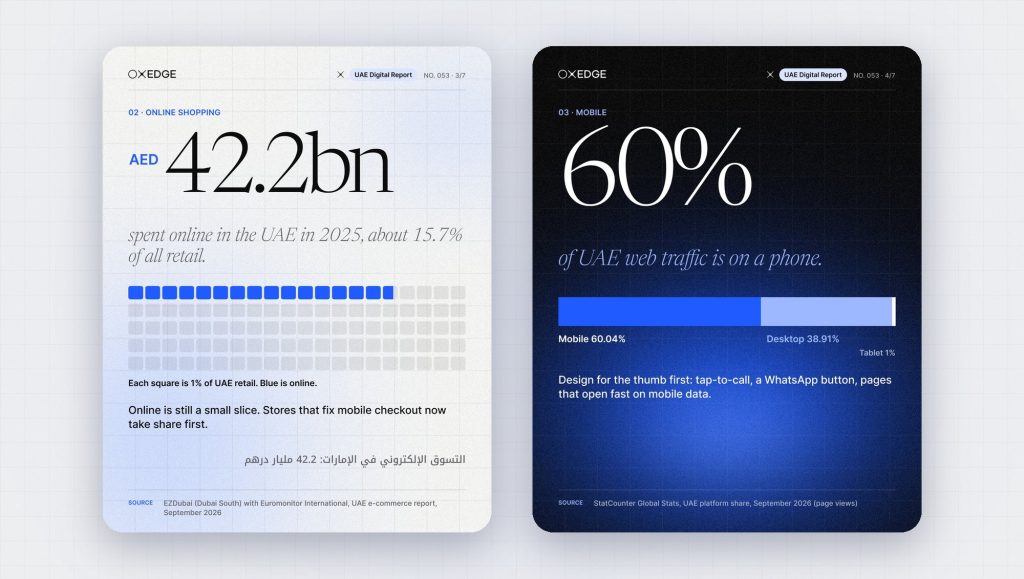
Sources: EZDubai and Euromonitor, via Zawya · StatCounter, UAE platform share
A checkout audit: problem, fix and how to measure
Walk through your checkout on a phone, in both languages, as a first-time guest paying by card, wallet and cash on delivery. The table turns common problems into fixes with a number to watch.
| Problem | Fix | How to measure |
|---|---|---|
| Costs shown late | Fees and the free-delivery threshold in the cart | Drop-off before delivery details |
| Forced account | Guest first; account after the order | Share of orders placed as guest |
| Postcode field | Emirate list, map pin, optional Makani | Errors and exits at the address step |
| No delivery date | Date and cut-off by emirate | Drop-off at the delivery step |
| Missing wallets | Wallet buttons first on phones | Mobile conversion |
| No BNPL or COD | Add Tabby or Tamara, and COD where it pays | Conversion on baskets above your average order value |
| Bank approval drop-outs | In-page challenge, “approve in your app” note | Exits after payment details |
| English-only payment | Full Arabic checkout and emails | Conversion by language |
| Hidden returns terms | Returns summary beside the pay button | Pre-purchase questions about returns |
Then score your checkout: tick each statement that’s true today.
0 of 12
- Prices include VAT on every page
- Delivery and COD fees show in the cart
- Shoppers see a delivery date and cut-off time
- Guest checkout is the most visible option
- No postcode field; emirate list and map pin instead
- The phone field says why we ask
- Apple Pay and Google Pay come first on phones
- BNPL and cash on delivery are offered where they suit
- Bank approval stays in our page
- The whole checkout works in Arabic
- GA4 records every checkout step
- Cart reminders go only to opted-in shoppers
Ten or more: move on to measurement and testing. Six to nine: close the gaps in the order of the audit table. Five or fewer: start with costs, guest checkout and payment methods.
How OXEDGE does this
We audit and rebuild UAE checkouts around how your shoppers actually pay and describe their address.
- A funnel review of your GA4 data and store orders, split by device, language and payment method.
- A recorded walk-through on real phones in Arabic and English, as a guest, with every payment route tested.
- A redesigned checkout: guest first, VAT-inclusive totals early, delivery dates by emirate, map pin address, wallets, BNPL and COD.
- A GA4 event set-up with a checkout dashboard, plus opted-in recovery flows and a testing plan.
Measuring the checkout funnel in GA4
Google’s recommended ecommerce events map onto a checkout: view_cart, begin_checkout, add_shipping_info with a shipping_tier, add_payment_info with a payment_type, and purchase with transaction_id, value, tax and shipping. Google asks you to send the currency, here AED, whenever you send a value.
Source: Google Analytics developer documentation, measure ecommerce
Then build a funnel exploration. GA4 allows up to ten steps; a closed funnel starting at begin_checkout counts only real checkout starts, and a breakdown by device category shows whether phones lose more shoppers. Elapsed time shows where shoppers stall.
Source: Google Analytics Help, funnel exploration
Send payment_type values that match your real options, such as Apple Pay, card, Tabby and cash on delivery. Register the page language as a custom dimension to compare Arabic and English checkouts. Reconcile GA4 purchases with store orders weekly, because analytics never counts every order.
Reconcile GA4 purchases with store orders weekly, because analytics never counts every order.
Recovering abandoned carts by email and WhatsApp
Recovery only works on shoppers you can contact and who agreed to hear from you. Federal Decree-Law No. 14 of 2023 gives consumers the right to choose whether to receive advertising by phone, email or social media. The PDPL, Federal Decree-Law No. 45 of 2021, in force since 2 January 2022, bars processing personal data without consent outside defined exceptions. Add separate unticked opt-in boxes for email and WhatsApp.
Sources: Ministry of Economy, Federal Decree-Law No. 14 of 2023, Article 6(4) · u.ae, data protection laws
Email is the cheaper channel. Klaviyo’s benchmarks, drawn from more than 110,000 of its customers, put average revenue per recipient for an abandoned cart email at USD 6.77. Klaviyo describes a common sequence: a reminder two to four hours after the shopper leaves, then messages around 24 and 48 hours.
Source: Klaviyo, abandoned cart benchmarks
WhatsApp needs more care. Meta classes abandoned-cart reminders as marketing templates, and a template that mixes an order update with a promotion also counts as marketing. Since 1 October 2026 Meta also charges for service messages, the free-form replies inside the 24-hour window after a shopper writes. 360dialog reports 1,000 free per business number a month, then USD 0.0157 each in the UAE, and notes that UAE marketing rates changed the same day.
Sources: Meta, template category guidelines · Meta for Developers, non-template message pricing · 360dialog, service message charging from October 2026
WhatsApp’s policy requires opt-in, recommends a separate opt-in per message category and requires every opt-out to be honoured. Send one WhatsApp reminder at most and let email carry the rest. For an assistant that answers questions in that chat, see our guide to AI agents for UAE online stores.
Source: WhatsApp Business Messaging Policy (last updated 23 September 2026)
Keep discounts out of the first reminder: if leaving earns a code, shoppers learn to leave. Compare recovered orders with a holdout group that gets no reminder.
A/B testing checkout changes without fooling yourself
Some fixes need no test: removing a postcode field or showing fees earlier is simply correct. Test where the answer is unclear, such as one page against several steps. Google Optimize closed on 30 September 2023, so use a testing tool that connects to GA4 or your platform’s own experiments feature.
Source: Google, Optimize sunset notice
Optimizely advises running tests for at least one business cycle of seven days, and notes that you need far more traffic to detect a small change than a big one. A store with a few hundred checkouts a week should ship the obvious fixes and save testing for bigger changes. Test one change at a time, with orders per checkout started as the main metric.
Source: Optimizely, how long to run an experiment
Never test across White Friday or Ramadan, when shoppers behave differently; freeze checkout changes before a peak. Our article on whether your store will survive White Friday covers that preparation.
Frequently asked questions
What is a good checkout abandonment rate for a UAE store?
There’s no reliable public UAE benchmark, and global averages include browsers. Compare your own funnel month by month, split by device and language.
Should we offer cash on delivery?
Offer it if your first-time buyers expect it, and price in the cost of refused parcels. Show any fee in the cart and confirm cash orders before dispatch.
Does buy now pay later reduce abandonment?
We found no independent UAE data on its effect. Add it, then compare conversion on larger baskets with the weeks before.
Why do customers abandon checkout in UAE online stores?
The biggest fixable reason is extra costs: 40 per cent of abandoning shoppers in Baymard’s US survey left over them. Slow delivery (20 per cent), card security doubts (19 per cent) and forced accounts (18 per cent) follow. Adyen reports that 54 per cent of UAE shoppers leave if they can’t pay their preferred way.
How do you measure checkout abandonment in GA4?
Send view_cart, begin_checkout, add_shipping_info, add_payment_info and purchase, with currency set to AED. Then build a funnel exploration of up to ten steps and break it down by device category to see whether phones lose more shoppers.
Can we recover abandoned carts on WhatsApp?
Only for shoppers who opted in. Meta classes cart reminders as marketing templates, so send one WhatsApp reminder at most and let email carry the rest. Add separate unticked opt-in boxes for email and WhatsApp.
Work with OXEDGE
Turn more of your started checkouts into paid orders, in Arabic and English.
We would start with your GA4 funnel and a walk-through of your checkout on real phones, then rank the fixes by likely impact and effort. You leave the first conversation knowing where your shoppers drop out and what to change first.