


Quick answer: The UAE e-invoicing deadline has passed: UAE businesses with revenue of AED 50 million or more had to appoint an accredited e-invoicing service provider by Friday 30 October 2026, and must go live on 1 January 2027. Missing the date costs AED 5,000 for each month or part of a month. The Ministry of Finance register listed 80 accredited providers on 29 October 2026. Everyone else has until 31 March 2027.
The UAE e-invoicing deadline fell on Friday 30 October 2026, the first hard date of the rollout. By that date, every business with revenue of AED 50 million or more must have appointed an Accredited Service Provider (ASP) under Ministerial Decision No. 66 of 2026. The appointment is the first step, not the last: after signing, the business starts onboarding through EmaraTax, tests with the provider and must issue e-invoices through the system from 1 January 2027. October also brought new rules on providers, tax groups and storage. Here is what was due, what changed and what to do now.
Key takeaways
- Revenue of AED 50 million or more: the deadline to appoint an ASP was 30 October 2026; go live by 1 January 2027.
- A late appointment carries a penalty of AED 5,000 for each month or part of a month, so appoint now rather than wait.
- Since 1 October 2026 only accredited providers may offer the service; the register listed 80 on 29 October 2026.
- Invoices between members of a tax group are excluded for 24 months from 1 January 2027, and the UAE-only storage rule is gone.
Sources: Ministerial Decision No. 66 of 2026 · Cabinet Decision No. 106 of 2025 · MoF register of Accredited Service Providers, last updated 29 October 2026
What was due on 30 October 2026, and who it covers
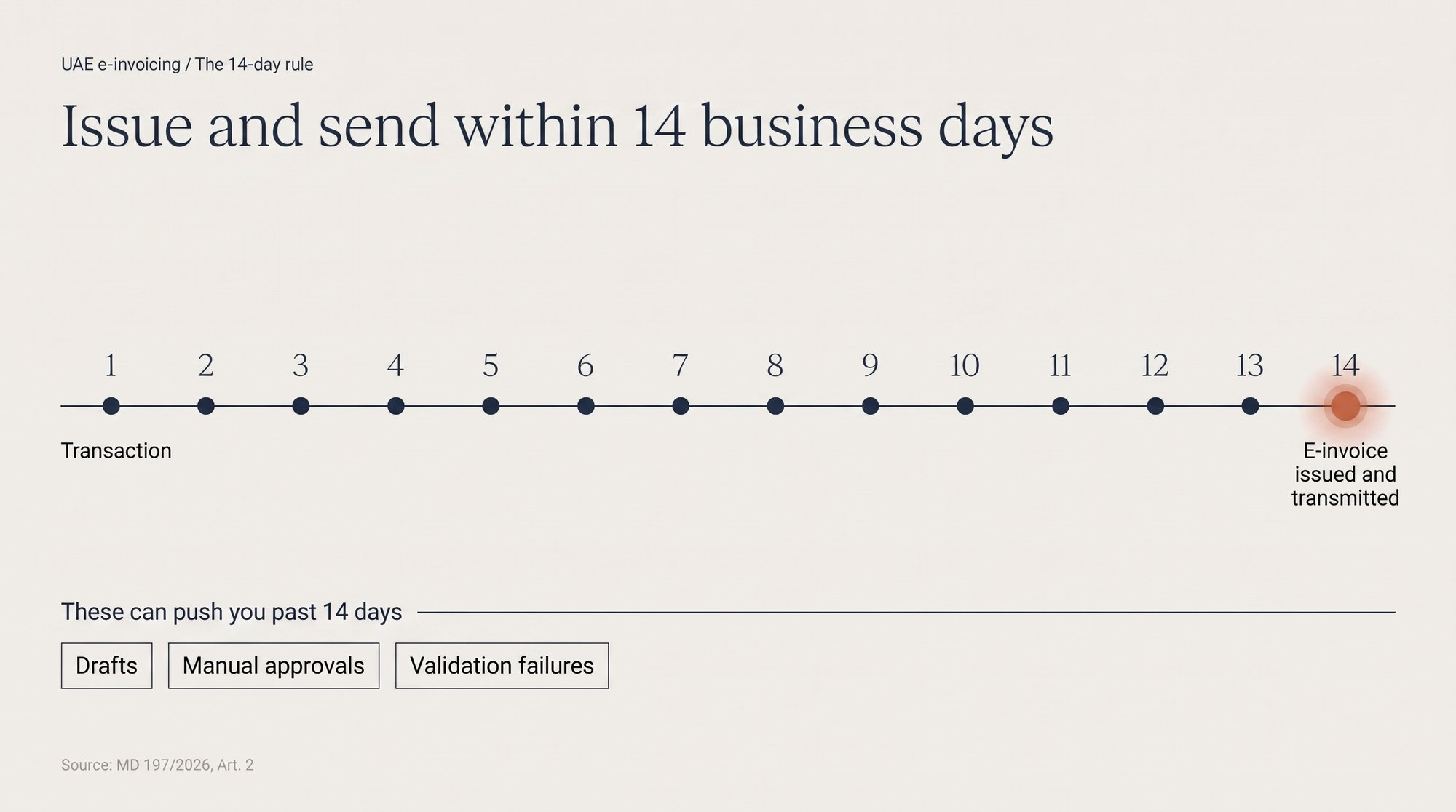
Ministerial Decision No. 66 of 2026 sets the first phase. A business with revenue of AED 50 million or more had to appoint an ASP by 30 October 2026 and must implement the e-invoicing system by 1 January 2027. The Ministry of Finance announced the change on 10 May 2026, moving the appointment date from 31 July to 30 October 2026 and keeping the January go-live date.
Sources: Ministerial Decision No. 66 of 2026 · MoF, 10 May 2026
Appointing means a signed agreement with a provider on the Ministry’s register. Only accredited providers may offer the service, and one provider handles both sending and receiving. On 29 October 2026 the register listed 80 accredited providers and no longer showed a separate final-assessment list. Keep the provider’s accreditation number on file.
Sources: MoF register of Accredited Service Providers, checked 29 October 2026 · Ministerial Decision No. 168 of 2026, Article 3 · UAE Electronic Invoicing Guidelines v1.1
If you still need to choose, our guide to the questions to ask an e-invoicing provider has a 12-point scorecard.
The rules: Dates come from Ministry of Finance Ministerial Decision No. 244 of 2025 as amended by No. 66 of 2026; provider rules from No. 168 of 2026; core rules from No. 243 of 2025 as amended by No. 197 of 2026; penalties from Cabinet Decision No. 106 of 2025. This article is general guidance, not legal or tax advice; confirm your position with a registered tax agent.
Sources: Ministerial Decision No. 244 of 2025 · Ministerial Decision No. 197 of 2026 · Cabinet Decision No. 106 of 2025
Does the UAE e-invoicing deadline apply to you?
Tick what is true for your business to see your dates and next step.
For tax groups, the exclusion covers only invoices between members; invoices to outside customers stay in scope. Each member onboards with its own Tax Identification Number and may use a different provider.
Sources: Ministerial Decision No. 197 of 2026, Article 4(1)(f) · UAE Electronic Invoicing Guidelines v1.1, Appendix 1
What changed in October: the rules before and now
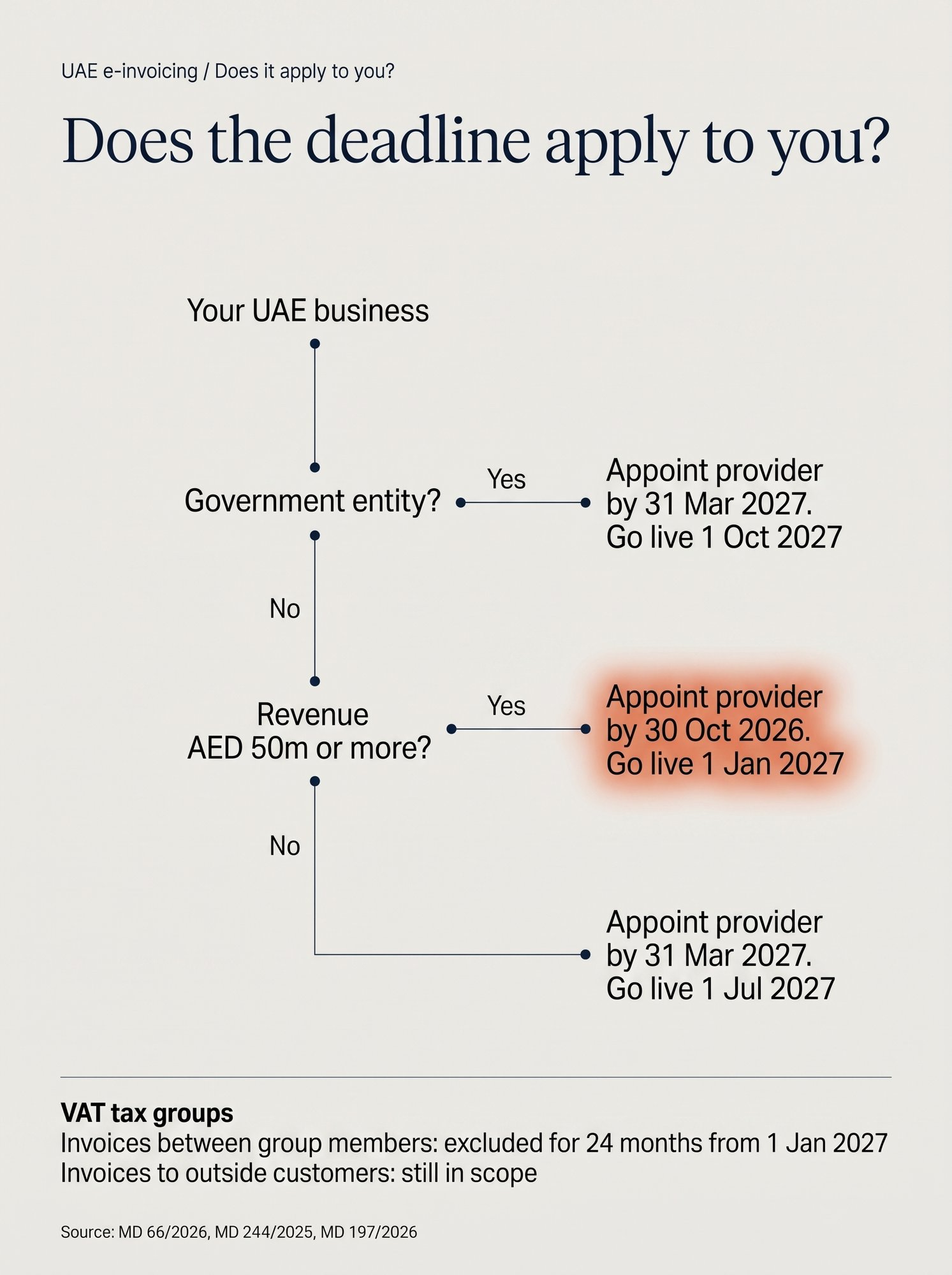
Two Ministerial Decisions took effect on 1 October 2026. Ministerial Decision No. 168 of 2026 replaced the provider rules and removed the pre-approval stage; the Ministry announced it on 9 October. Ministerial Decision No. 197 of 2026, announced on 19 October, amends the core e-invoicing rules.
| Rule | Before October 2026 | Now | Where |
|---|---|---|---|
| Approval process | Providers could hold pre-approval before full accreditation | Accreditation only; pre-approved providers had 30 days from 1 October 2026 to complete it | MD 168 of 2026, Article 19 |
| Tax group transactions excluded | Invoices between tax group members were in scope | Excluded for 24 months from 1 January 2027 | MD 197 of 2026, Article 4(1)(f) |
| UAE storage rule removed | E-invoices had to be stored in the UAE | Keep them for the Tax Procedures Law period and produce them to the FTA on request | MD 197 of 2026, Article 11 |
| Outage notice repealed | A system failure had to be notified to the FTA within two business days | Article 12 is repealed; no such notice is required | MD 197 of 2026 |
Sources: Ministerial Decision No. 168 of 2026 · MoF, 9 October 2026 · Ministerial Decision No. 197 of 2026 · MoF, 19 October 2026
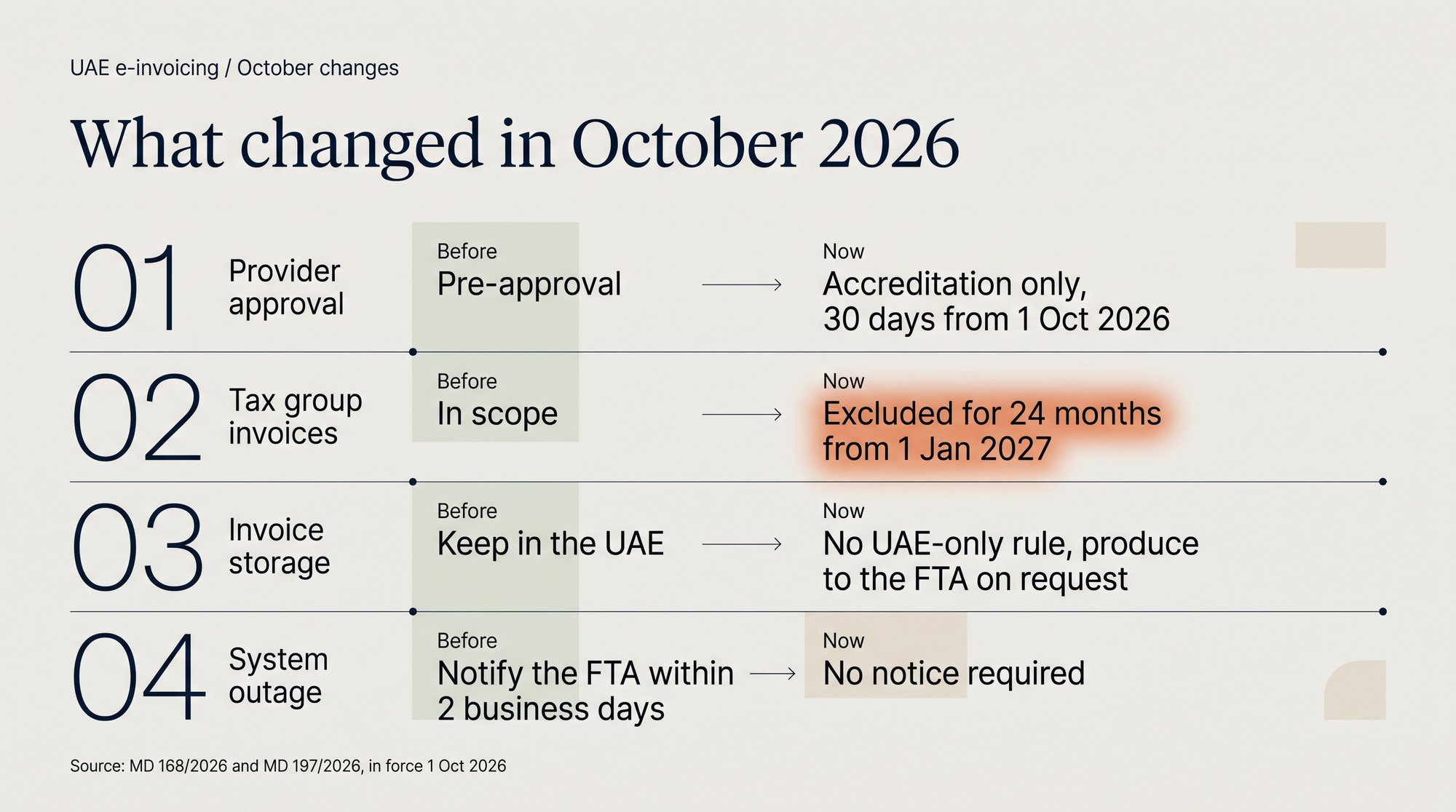
Ministerial Decision No. 197 of 2026 also replaces Article 6(5): e-invoices must be issued and transmitted within 14 business days from the date of the transaction, subject to clause 4 of that article. Invoices that sit in a draft queue, wait for manual approval or fail validation can run past that window, so build the timing into the integration and the rejection workflow.
Source: Ministerial Decision No. 197 of 2026, Article 2

The storage change matters for hosting decisions, but it isn’t a free pass. Your sector’s own data rules still apply. Our full guide to what UAE businesses must do for e-invoicing covers the wider rules.
The storage change matters for hosting decisions, but it isn’t a free pass.
Missed the deadline? What to do this week
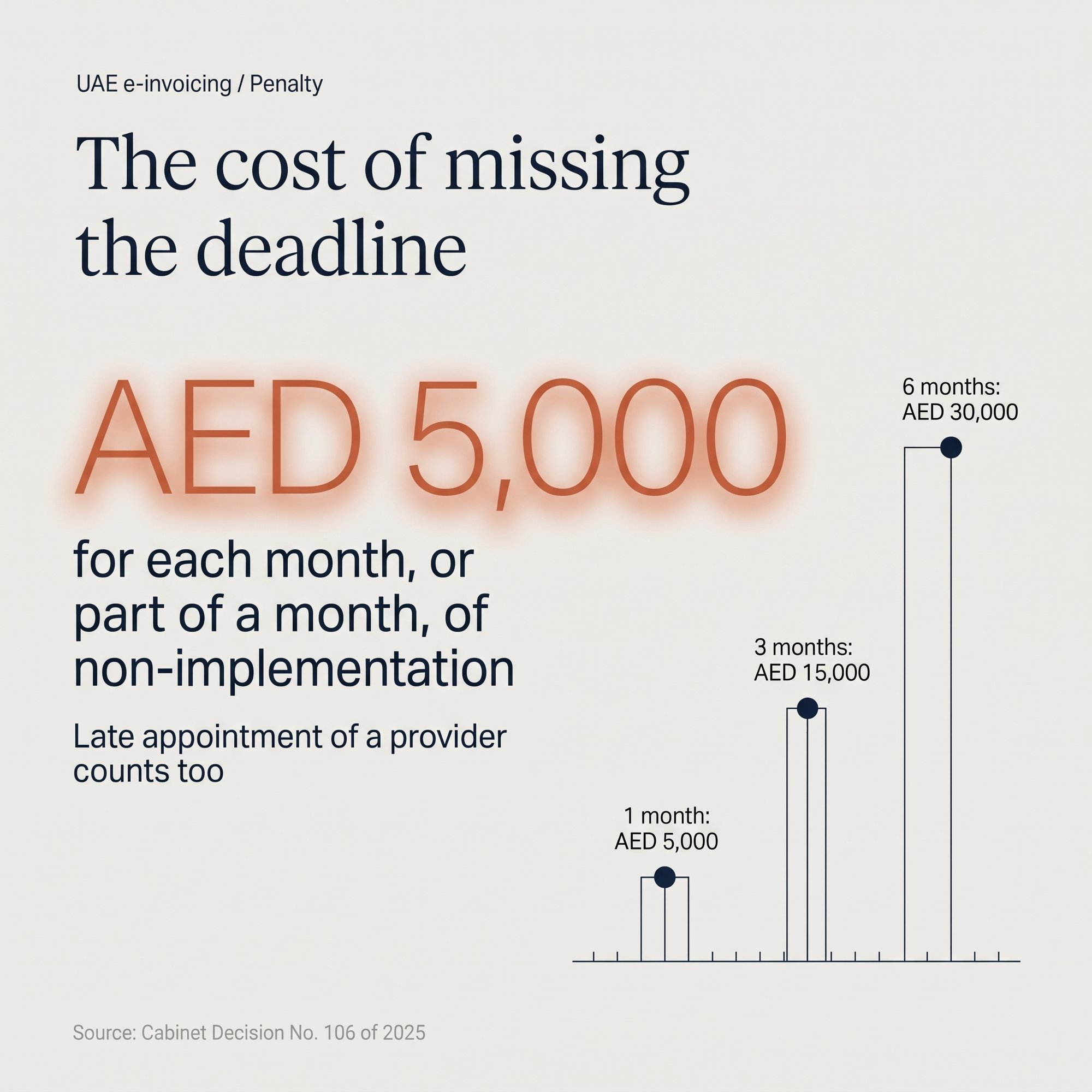
Cabinet Decision No. 106 of 2025 sets a penalty of AED 5,000 for each month, or part of a month, that a business fails to implement the system, which includes failing to appoint an ASP on time. Because part of a month counts, a few days of delay into a new month add another AED 5,000. The fix is the same whether you’re one day late or one day early: sign with an accredited provider now.
Source: Cabinet Decision No. 106 of 2025, annexed table
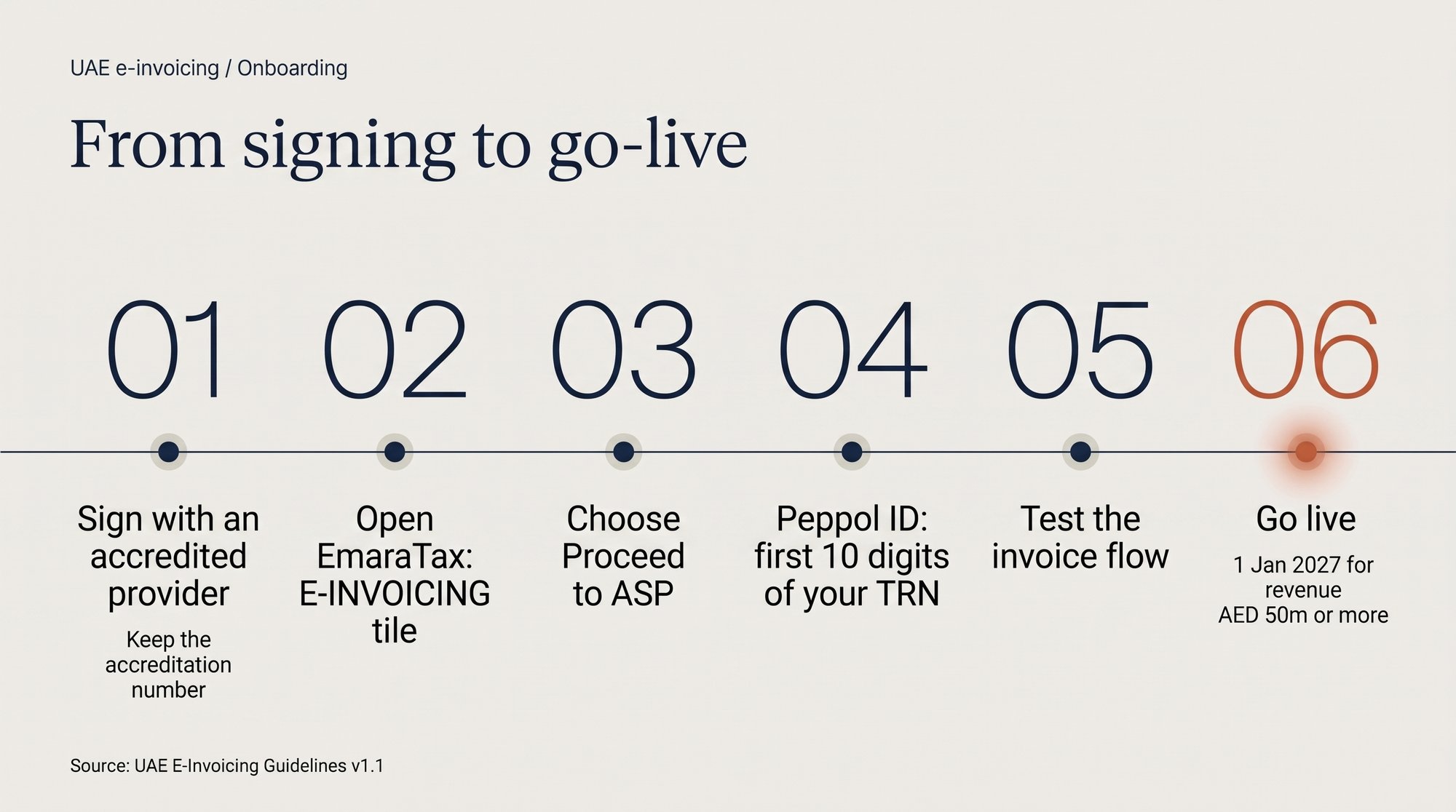
After signing, the work moves to your side. The Ministry’s guidelines describe four steps: understand the requirements, select a provider, test and go live. Your business starts onboarding, not the provider: once the contract and commercial terms are in place, your EmaraTax account admin opens the E-INVOICING tile, chooses “Proceed to ASP” and is passed to the provider. Your Peppol participant identifier is issued as part of onboarding and is based on your Tax Identification Number, the first 10 digits of your TRN.
Source: UAE Electronic Invoicing Guidelines v1.1, 1 June 2026
Sources: UAE Electronic Invoicing Guidelines v1.1 · Ministerial Decision No. 66 of 2026
This week, three things matter most:
- Sign with an accredited provider and keep the dated agreement and its accreditation number.
- Have your EmaraTax account admin start onboarding for each legal entity and tax group member.
- List every system that issues or receives invoices, from the ERP to point of sale and spreadsheets, with an owner for each.
The ERP side is usually the larger job. A provider can only send what your systems give it: buyer identifiers, tax codes on every line, credit notes linked to the original invoice. Nine weeks is enough to connect a clean ERP, but not to rebuild messy master data from scratch. If the ERP is due for replacement anyway, connect the current one first and see our guide to what Odoo ERP costs in the UAE for the next step.
Nine weeks is enough to connect a clean ERP, but not to rebuild messy master data from scratch.
How OXEDGE does this
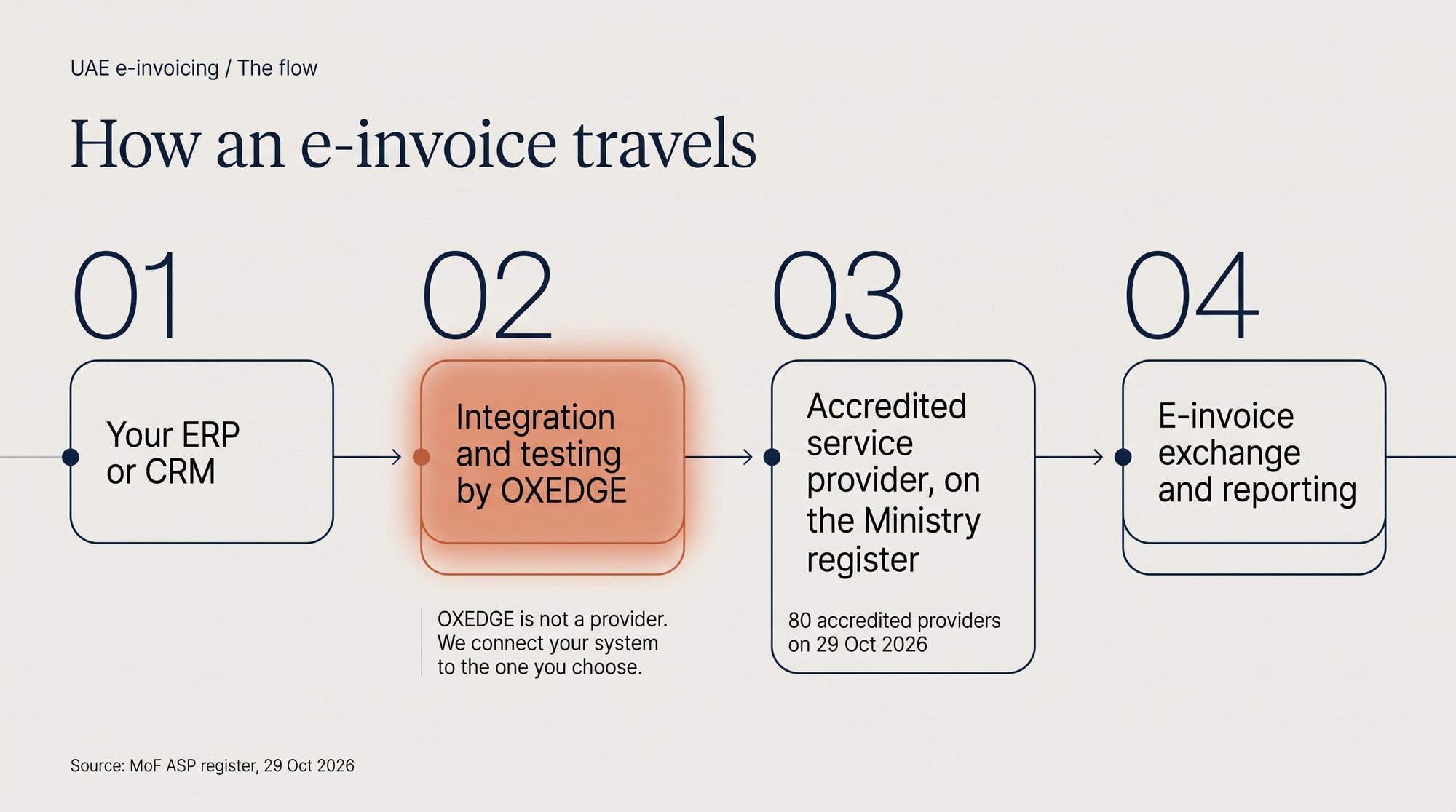
We connect your ERP or CRM to the provider you appointed, so invoices pass first time from 1 January 2027.
- An invoicing map: every system that issues or receives invoices, and the fields each one is missing.
- Data mapping from your ERP or CRM to the provider’s format, including tax codes, buyer identifiers and credit notes.
- The integration itself, with rejections and supplier invoices flowing back into your records.
- A test plan with key customers and suppliers, run before go-live, and a runbook for rejected invoices.
To be clear: OXEDGE isn’t an Accredited Service Provider and isn’t on the Ministry’s register. We work on the ERP and CRM integration side, alongside the provider you choose; see our case studies.
The timeline to 2027
Select a date to see what happens on it.
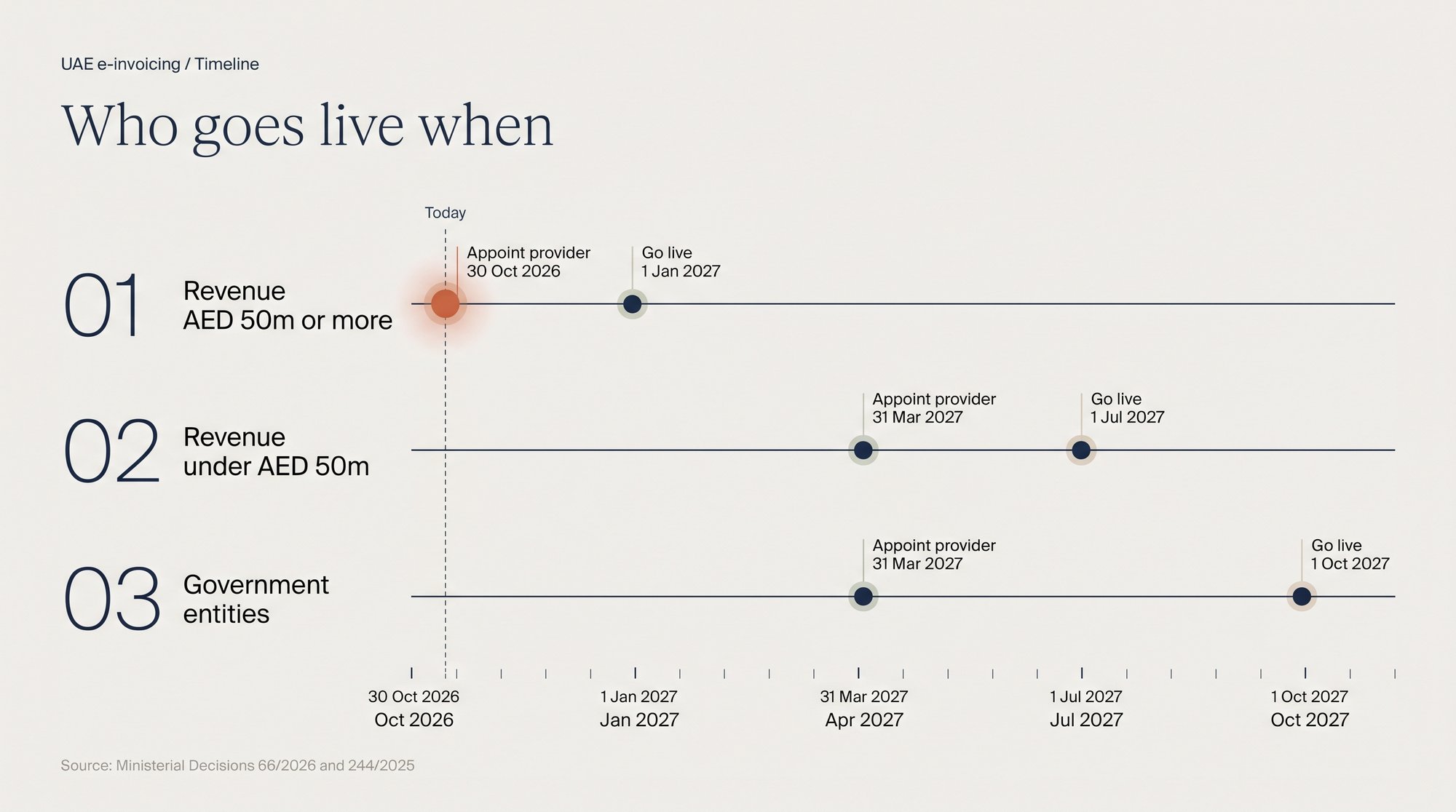
| Who | Appoint an ASP by | Go live by |
|---|---|---|
| Revenue of AED 50 million or more | 30 October 2026 | 1 January 2027 |
| Revenue below AED 50 million | 31 March 2027 | 1 July 2027 |
| Government entities | 31 March 2027 | 1 October 2027 |
Sources: Ministerial Decision No. 66 of 2026 · Ministerial Decision No. 244 of 2025, Article 5 · Ministerial Decision No. 197 of 2026
Below AED 50 million: what to do now
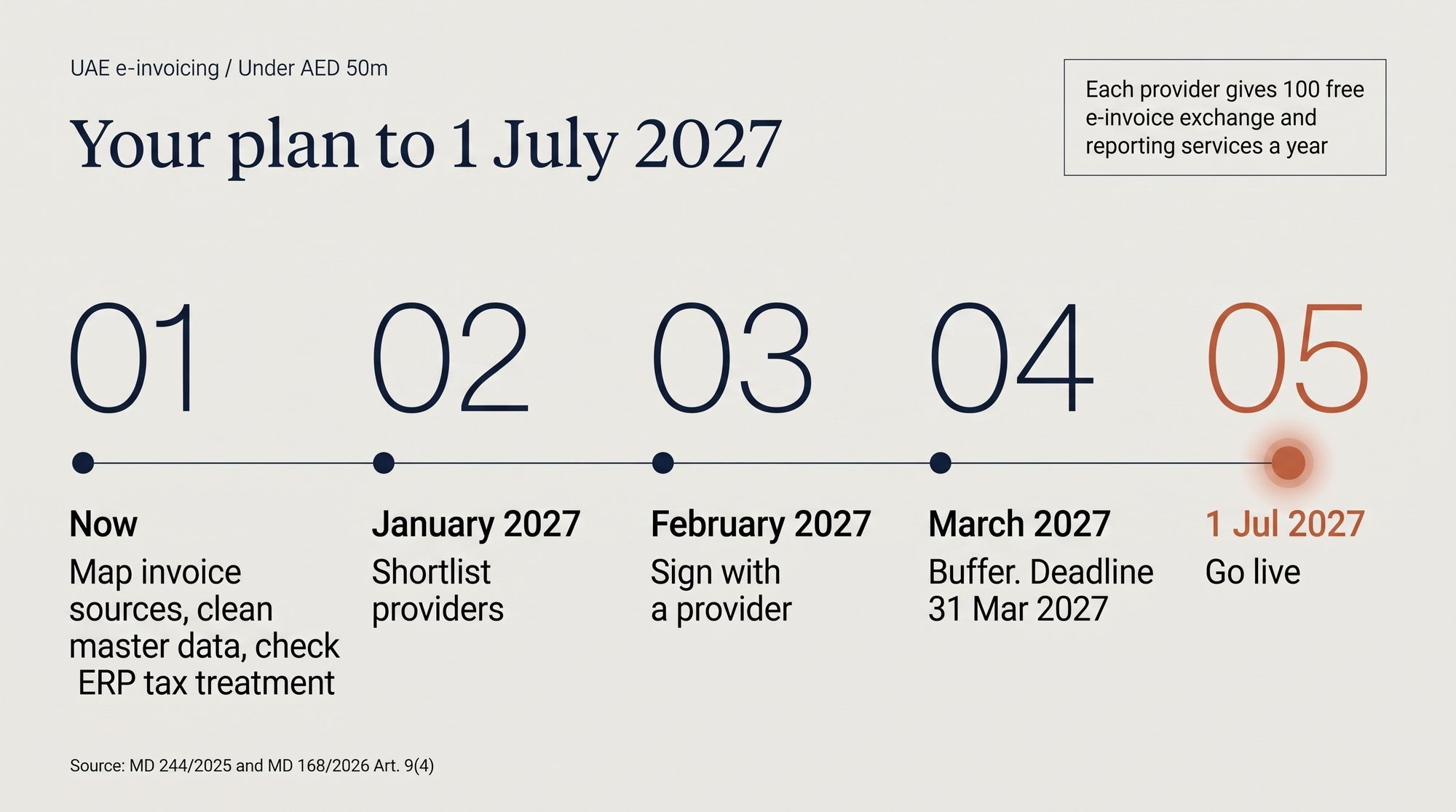
If your revenue is below AED 50 million, your appointment date is 31 March 2027 and your go-live date is 1 July 2027, under Ministerial Decision No. 244 of 2025. Five months sounds like plenty until you allow for data clean-up, demos, contract review and onboarding.
Source: Ministerial Decision No. 244 of 2025, Article 5
Start with the work that does not depend on a provider: map invoice sources, clean customer and supplier records and check the tax treatment on every ERP line. Then shortlist providers in January and sign in February, leaving March as a buffer. Each provider must give each customer 100 free e-invoice exchange and reporting services a year from the date the agreement is signed, so a small business should compare quotes on its real volumes.
Source: Ministerial Decision No. 168 of 2026, Article 9(4)
If you run on spreadsheets or a basic accounting app, ask now whether it can connect to a provider at all. Better to learn that in November than in March.
Questions UAE businesses ask
Was it enough to sign by 30 October, or must we also be onboarded?
Signing by 30 October 2026 met the appointment deadline. Onboarding through EmaraTax and testing follow, before go-live on 1 January 2027.
Do invoices between our group companies need to be e-invoiced?
Not for 24 months from 1 January 2027, under Ministerial Decision No. 197 of 2026, as long as the companies are members of the same VAT tax group. Invoices to customers outside the group are still in scope.
Do our e-invoices still have to be stored in the UAE?
Not under the e-invoicing rules since Ministerial Decision No. 197 of 2026. Keep them for the Tax Procedures Law period and produce them to the FTA on request.
Can OXEDGE be our e-invoicing provider?
No. OXEDGE is not an Accredited Service Provider. We connect your ERP or CRM to the accredited provider you choose and test the flow end to end.
Work with OXEDGE
Signed with a provider? Get your ERP ready for 1 January 2027.
Book a 30-minute ERP integration call and bring your provider’s name and a list of the systems that issue invoices. You leave with the data gaps we found, the integration work behind them and a test plan you can start this month.