
Dubai has no shortage of web design agencies, and most of their portfolios look good. That’s exactly why choosing one is hard: the differences that decide whether your project succeeds are invisible in a showreel. They sit in how the agency handles Arabic, who owns the code and the accounts when the project ends, what “done” means in the contract, and who answers the phone six months after launch. This is a practical checklist for choosing a web design agency in Dubai: what to prepare, what to verify, what to ask, what to put in the contract, a request-for-proposal template, and a scorecard to compare your shortlist.
Quick answer: How to choose a web design agency in Dubai: write your own brief first, then shortlist three to five agencies and check their trade licence, TRN and live Arabic sites on your own phone. Send each the same RFP, write acceptance criteria into the contract, and keep the domain, hosting and code in your company’s name from day one.
Sources: DataReportal, Digital 2026: the United Arab Emirates · Statcounter, UAE platform market share · W3Techs, content languages, October 2026 · web.dev, Core Web Vitals
Write your own brief before you meet anyone
The single biggest predictor of a good agency choice is a client who knows what they’re buying. Without a brief, every agency answers a different question, the quotes can’t be compared, and the cheapest proposal wins by describing the smallest project. Spend a week on these six points before the first call.
- The business goal. Leads, bookings, online sales, recruitment or credibility with investors. One primary goal, with a number attached if you have one.
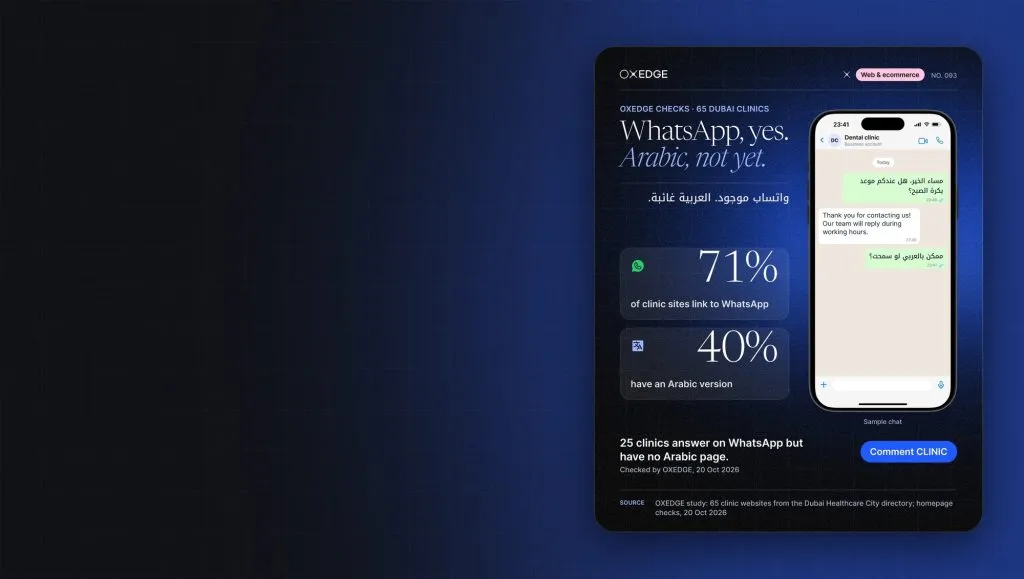
- The audience and languages. Who visits, from which devices, and whether Arabic is a full version of the site or a summary page. With six in ten UAE visits on mobile, the phone layout is the main layout.
- Scope. Number of page templates, content types (projects, listings, products, articles), forms and any customer accounts.
- Integrations. CRM, booking system, payment gateway, ERP, WhatsApp, analytics. Each one is a cost line and a risk.
- Content. Who writes the copy in each language, who supplies photography, and by when.
- Budget band and deadline. A range, not a secret. Agencies design to the budget; hiding it means proposals you cannot use.
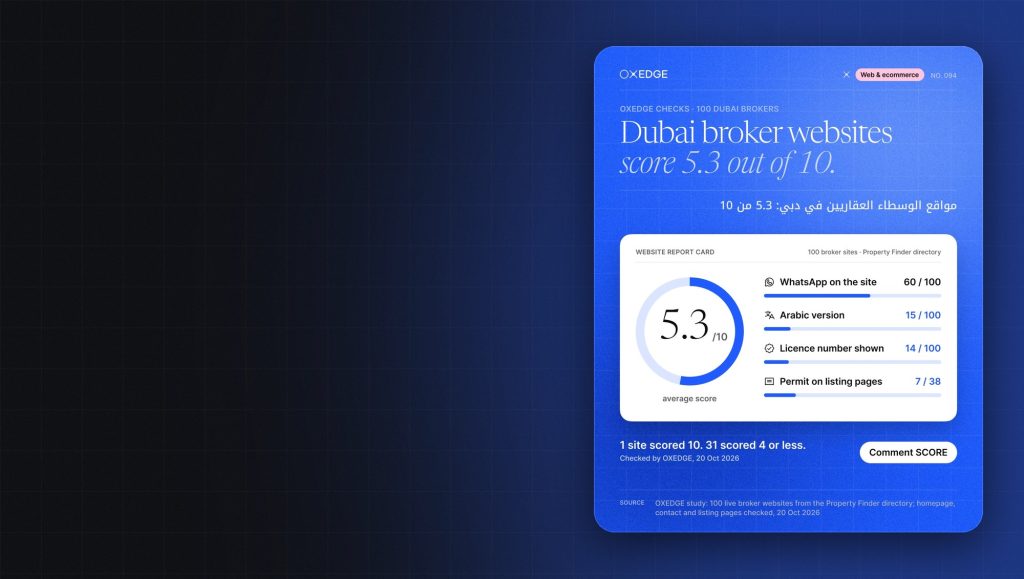
Arabic deserves a decision of its own. Only 0.6 per cent of websites worldwide have Arabic content, so the pool of agencies with deep right-to-left experience is far smaller than the pool that will say yes. If Arabic matters to your customers, make it a selection criterion rather than a line item, and read our twelve things that break in Arabic-first UX before you brief anyone.
Source: W3Techs, usage statistics of content languages for websites
Building a shortlist: what to verify before the pitch
Aim for three to five agencies. More than that and you won’t have time to evaluate them properly; fewer and you have no basis for comparison. Before inviting anyone to pitch, run the checks below. None takes more than a few minutes, and together they remove most of the risk.
| Check | How | Why it matters |
|---|---|---|
| Trade licence | Look the company up on the UAE National Economic Register | Confirms the business exists, is licensed and is licensed for the activity it is selling you |
| Tax registration | Check the TRN on the FTA’s free TRN verification service | A VAT-registered agency must issue valid tax invoices; the registered name should match the contract |
| Live work | Open three portfolio sites on your own phone, on mobile data | Screenshots hide slow pages, broken Arabic and abandoned sites |
| Arabic work | Ask for live bilingual sites and switch the language on each | Proves right-to-left layout, Arabic typography and mirrored components have been done before |
| References | Speak to two clients, one of them from more than a year ago | Launch-day happiness tells you little; year-two support tells you a lot |
| Who does the work | Ask which roles are in-house and which are subcontracted | Subcontracting is common and fine if disclosed; it changes who you depend on |
Sources: u.ae, National Economic Register · TRN verification on the FTA e-services portal
The live-site check is the most revealing. A portfolio site that loads slowly on a phone tells you more about the agency’s habits than any case study. So does a mirrored Arabic version with the icons still pointing the wrong way, or a site that has not been updated since launch.
A portfolio site that loads slowly on a phone tells you more about the agency’s habits than any case study.
How to choose a web design agency: questions to ask in the first meeting
These questions separate agencies that have thought about the whole life of a website from those that think about launch day. Listen for specifics: names of tools, examples from past projects, numbers.
| Question | A good answer sounds like | A warning sign |
|---|---|---|
| Who will work on our project, and how much of their time? | Named people and roles, with the project lead you will speak to every week | “Our team” with no names; the senior person in the pitch disappears after signing |
| How do you handle Arabic? | Arabic designed alongside English, native-speaker review, right-to-left testing on real devices | “We translate it at the end” or “the plugin handles it” |
| What platform do you recommend, and why for us? | A recommendation tied to your content, integrations and team skills, with trade-offs | The same platform for every client, or a proprietary system only they can maintain |
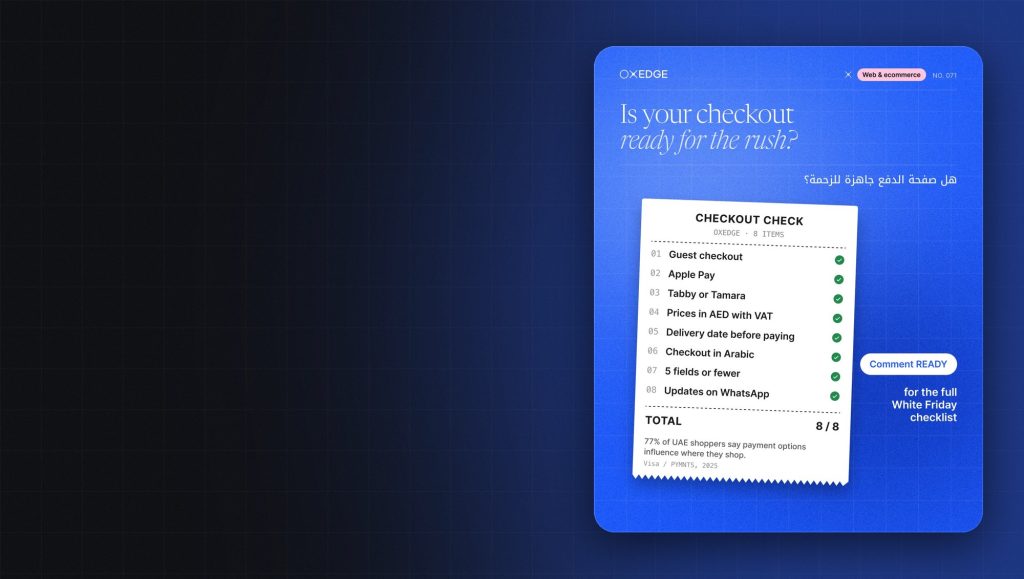
| How will we know the site is fast? | Core Web Vitals targets in the acceptance criteria, measured on mobile | “It will be fast” with no measure |
| What happens after launch? | A defined warranty period, a support agreement with response times, and a handover pack | Vague offers to “help if anything comes up” |
| Who owns the code, design files and accounts? | You do, on final payment, with accounts registered in your company’s name from day one | Hesitation, or “we host everything for you” |
The request-for-proposal template

Send every shortlisted agency the same document and ask them to answer in the same structure. A ten-page RFP is plenty for most company websites. Use these sections.
| Section | What to include |
|---|---|
| 1. About us | What the company does, customers, markets, current site and what is wrong with it |
| 2. Goals and measures | The primary goal, two or three secondary goals, and how success will be measured six months after launch |
| 3. Audience and languages | Visitor types, devices, Arabic and English requirements, any further languages |
| 4. Scope | Page templates, content types, forms, accounts, search, number of pages to migrate |
| 5. Integrations | Every system the site must talk to, with the system name and who administers it |
| 6. Content and assets | Who writes, translates and photographs; what exists already; brand guidelines |
| 7. Technical requirements | Hosting preferences, data protection, performance targets, accessibility level, analytics |
| 8. Timeline and budget band | Launch date and any hard deadline, the budget range, and payment expectations |
| 9. What we want back | Approach, team, timeline, itemised cost, support options, three references, sample contract |
| 10. How we will decide | The scoring weights below, the decision date and the contact for questions |
Publishing your scoring weights in the RFP is unusual and useful: it tells agencies what matters to you, and it stops the decision drifting towards whoever gave the most polished presentation. A sensible default for a company website is quality of relevant work 25 per cent, understanding of your goals 20 per cent, Arabic and mobile capability 15 per cent, team and process 15 per cent, support and handover 10 per cent, and price 15 per cent. Adjust the weights to your situation, but write them down before the proposals arrive.
Contract, IP ownership and payment terms
Most disputes between companies and web agencies are about three things: who owns what, what counts as finished, and what happens when the relationship ends. All three are settled in the contract, before any design work begins.
Ownership. Under the UAE’s Federal Decree-Law No. 38 of 2021 on Copyright and Neighbouring Rights, unless otherwise agreed in writing, copyright in a work made in favour of another person is attributed to that person, and software and databases are protected works. “Unless otherwise agreed” is the important part: agency terms often agree otherwise, and the law requires a transfer or licence of economic rights to be in writing, specifying the right, its purpose, duration and place. Your contract should state plainly that the company owns the custom code, designs and content on final payment, and list what is licensed rather than owned: themes, plugins, fonts, stock photography and any agency framework reused across clients.
Source: Federal Decree-Law No. 38 of 2021, Articles 2, 9 and 28
Personal data. Your website collects personal data through every form, and Federal Decree-Law No. 45 of 2021 on the Protection of Personal Data generally prohibits processing it without consent. The agency and any host it appoints handle that data on your behalf, so the contract needs data protection terms: where data is hosted, who can access it, and what happens to it when the contract ends. Our PDPL guide for product teams covers the detail. This article is general guidance, not legal advice; have a lawyer review the final contract.
Source: u.ae, data protection laws
Acceptance criteria. “Finished” should be measurable. Write the targets into the contract: Core Web Vitals in the “good” range on mobile (Largest Contentful Paint within 2.5 seconds, Interaction to Next Paint of 200 milliseconds or less, Cumulative Layout Shift of 0.1 or less), WCAG 2.2 level AA for accessibility, every page working in both languages on named devices and browsers, and all redirects from the old site in place.
Sources: web.dev, Web Vitals thresholds · W3C, WCAG 2.2
Payment. Tie payments to deliverables you can see, not to dates. A common structure is a deposit on signing, a payment on design approval, a payment on a working staging site, and the balance on launch and acceptance. Be wary of contracts that ask for most of the fee before you have seen anything that works.
How OXEDGE does this
We build websites you own outright, with Arabic designed in and acceptance criteria written into the contract.
- A discovery phase that turns your goals into a written scope, sitemap and integration list before any design.
- Arabic and English designed together, with native-speaker review and right-to-left testing on real phones.
- Domain, hosting, analytics and code repositories registered in your company’s name from day one.
- A handover pack: admin guides, credentials transfer, architecture notes and a support runbook.
Hosting, handover and life after launch
The most expensive mistake here isn’t a bad design; it’s a website where the domain, the hosting account and the code all sit in the agency’s name. Changing agency then means starting again. Insist on the following from day one: the domain registered to your company through an accredited registrar, the hosting or cloud account opened in your company’s name with the agency added as a user, the code in a repository you own, and analytics, Google Search Console and tag manager accounts owned by a company email address that isn’t tied to one employee.
The most expensive mistake here isn’t a bad design; it’s a website where the domain, the hosting account and the code all sit in the agency’s name.
At launch, ask for a handover pack: a list of every account and who holds admin rights, the architecture and integrations in plain language, how to update content in both languages, the backup and restore procedure, and the licence renewals that fall due each year. Then agree what support looks like. A warranty period for defects is standard; ongoing support should come with response times by severity, a monthly allowance of hours or a clear rate, and a commitment on security updates. Our DevOps baseline for small teams sets out the backups, monitoring and deployment practices a well-run site should have.
Red flags that should end the conversation
- A price before any questions. A quote sent after a five-minute call is a template, not a proposal for your business.
- Everything in their name. The agency registers the domain and hosts the site on its own account “to make it easier”.
- A proprietary system. A custom content management system only the agency can maintain, with no export path.
- Arabic as translation. No live bilingual work to show, and no native Arabic speaker on the team or the review process.
- No acceptance criteria. The contract says “website as per discussion” and payment is due on dates, not deliverables.
- Silence on support. No warranty period, no response times, no handover document in the proposal.
- Licence or TRN that does not check out. The name on the invoice does not match the licence or the tax registration.
Score your shortlisted agency
Run this for each agency after the pitch, using what they showed you rather than what they promised. Tick each statement that’s true.
0 of 12
- Their trade licence and TRN check out, and the names match the proposal
- We opened three live sites they built, on a phone, and they were fast and current
- They showed live bilingual sites and named who designs and reviews the Arabic
- We met the people who will work on our project, not only the sales team
- Their platform recommendation was explained in terms of our content, integrations and team
- The proposal itemises cost by phase and lists what is licensed rather than owned
- The contract transfers ownership of custom code, designs and content to us on final payment
- Domain, hosting, code and analytics accounts will be in our company’s name
- Acceptance criteria include mobile performance targets and an accessibility level
- Payments are tied to deliverables we can see and test
- Support comes with a warranty period, response times and a handover pack
- A client from more than a year ago told us they would hire them again
| Score | Reading | Next step |
|---|---|---|
| 0–5 | Too many unknowns to sign | Ask for the missing items in writing; if they cannot provide them, drop the agency |
| 6–8 | Workable, with gaps to close in the contract | Negotiate the missing points (usually ownership, acceptance criteria or support) before signing |
| 9–10 | A strong candidate | Compare on your weighted RFP score and on how the team made you feel about working together for a year |
| 11–12 | Rare; you have found a partner, not just a supplier | Check references once more, then move quickly |
Making the final decision
When two agencies score close, choose the one that asked you the harder questions. An agency that challenged your scope, questioned an integration or pushed back on a deadline was thinking about your project working, not about winning it. Then give the winner the same respect: share the scoring, tell the unsuccessful agencies why they lost, and start the project with a kickoff that confirms the brief, the team and the first milestone in writing.
Work with OXEDGE
Put us through this checklist: we would rather be chosen on it than on a showreel.
We start by turning your goals into a written scope, so our proposal can be compared line by line with anyone else’s. You leave the first conversation with a clearer brief, whichever agency you choose.
Frequently asked questions
How do I choose a web design firm in Dubai?
Write a brief, shortlist three to five agencies, verify them, send each the same RFP and score the proposals against weights you publish in advance.
How do I find a reliable web design partner in Dubai?
Check the trade licence on the National Economic Register and the TRN on the FTA service, open three live portfolio sites on your phone, and speak to two clients, one from over a year ago.
Should Arabic be part of the brief from the start?
Yes. Only 0.6% of websites worldwide have Arabic content, so deep right-to-left experience is rare. Decide whether Arabic is a full version or a summary page before you meet anyone.
Who should own the website code, domain and hosting account?
You should, with accounts registered in your company’s name from day one and code transferred on final payment. Otherwise changing agency means starting again.
What should a web design contract include?
Ownership of work, measurable acceptance criteria such as Core Web Vitals on mobile, payments tied to deliverables, and a handover pack with a support agreement.
What are the red flags when hiring a web design agency?
No named team, translating Arabic at the end, one platform for every client, no speed measure, and hesitation about who owns the code.