Quick answer: AI customer service works when you split tasks three ways. Automate what has one right answer in your systems, such as order status, FAQs and bookings. Let AI draft what needs judgement, like quotes. Keep people on complaints, VIP accounts, health or legal questions and payment disputes, with a handover that takes one step.
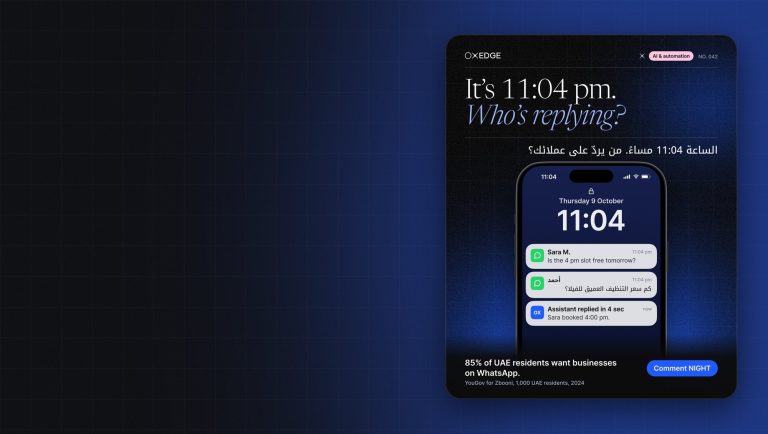
It is 11 pm in Dubai. One customer sends a WhatsApp voice note asking where their order is; another writes in Arabizi to move tomorrow’s appointment. Who answers? AI can now reply in seconds, look up the order and change the booking, yet UAE customers are just as clear that they want a real person within reach. This guide covers how support actually runs with AI: what to automate, what AI should only draft, what stays human, how to hand over, what to measure and how to roll it out in 90 days.
Sources: Zbooni and YouGov poll of 1,000 UAE residents, via Communicate (February 2024) · ServiceNow Consumer Voice Report 2025, 1,000 UAE adults, via Communicate (May 2025) · Salesforce State of Service, via Khaleej Times (January 2026)
What UAE customers expect from a support channel
Start with the channel. In a Zbooni poll run by YouGov among 1,000 UAE residents, 65 per cent had used WhatsApp to ask a business about a product or service in the past year, ahead of call centres (55 per cent) and email (48 per cent). 85 per cent want every business to offer WhatsApp for customer support. Our guide to where UAE customers message businesses covers the other channels.
Speed matters, and so does a person. ServiceNow’s Consumer Voice Report 2025, covering 1,000 UAE adults, found 89 per cent expect quick response times and 85 per cent expect a self-service option. Yet at least 68 per cent prefer to deal with people for support, and 47 per cent say chats with AI chatbots have not met their expectations; many see scripted replies and misunderstood slang as typical AI traits. The Zbooni poll found 87 per cent want a real person over a chatbot or AI.
Sources: ServiceNow Consumer Voice Report 2025, UAE findings, via Communicate (28 May 2025) · ServiceNow, methodology: Opinium, 17,000 adults in 13 countries, 10 to 17 January 2025 · Zbooni and YouGov, via Communicate
These findings do not conflict: customers want instant answers on simple things and a capable person on hard ones. Kantar’s 2025 research for Meta, across 22 markets including the UAE and Saudi Arabia, found 67.7 per cent agree that getting a response from an AI chatbot is helpful, while 66.8 per cent feel frustrated when messaging is not offered at all.
AI customer service by task: automate, draft or keep human
Every support task fits one of three modes. Automate fully: the AI answers or acts alone, and a person reviews samples. AI drafts, human sends: the AI prepares the reply and a team member approves it. Keep human: a person owns the conversation, with AI limited to summaries and lookups.
| Task | Mode | Why | Guardrail |
|---|---|---|---|
| Order and delivery status | Automate fully | One right answer in your systems | Verify the customer before sharing order details |
| Product and policy FAQs | Automate fully | Same questions every day | Answers only from approved content |
| Bookings and rescheduling | Automate fully | Clear rules and a live calendar | Confirm the new slot before saving it |
| Lead capture and qualification | Automate fully | Speed wins the lead | Hot leads go straight to a person |
| Refunds within policy | Agent acts within a limit | Most are small and rule-based | Cap set in the payment system; a person approves above it |
| Quotes and custom pricing | AI drafts, human sends | Margins and context need judgement | No price leaves without approval |
| Complaints | Keep human | Upset customers want someone accountable | AI summarises the history for the agent |
| VIP and key accounts | Keep human | The relationship is the product | Known numbers go to a named contact |
| Medical or legal questions | Keep human | Wrong answers cause harm and liability | AI books a qualified person |
| Payment disputes and fraud | Keep human | Money, identity and trust are at stake | Immediate handover; AI never reverses charges |
Customer trust lines up with this split. ServiceNow found only 24 per cent of UAE consumers are happy to use an AI chatbot to track a lost or delayed package, and 23 per cent trust one to book a car service. Just 13 per cent would trust AI to dispute a suspicious bank transaction.
Source: ServiceNow Consumer Voice Report 2025, UAE findings, via Communicate
The rule of thumb: automate what has one right answer in your systems, let AI draft what needs judgement, and keep people on disputes, health, legal questions and anger.
The rule of thumb: automate what has one right answer in your systems, let AI draft what needs judgement, and keep people on disputes, health, legal questions and anger.
Answer-only bots versus AI agents that take action
An answer-only bot reads your knowledge base and replies: it can explain the returns policy but cannot start a return. An AI agent connects to your systems through tools: it looks up the order, moves the booking, issues a refund under a set limit or opens a ticket. Gartner predicted in March 2025 that agentic AI will autonomously resolve 80 per cent of common customer service issues without human intervention by 2029. That is a forecast, not a measured result.
Source: Gartner press release, 5 March 2025, via CMSWire
An agent is only as useful as the systems behind it, which often means a proper CRM or ERP setup first. If the terms are new, start with our plain-English guide to AI automation.
Actions also bring new risks. OWASP, the open security community, calls the main one “excessive agency”: damaging actions carried out in response to unexpected, ambiguous or manipulated output from the model. UAE service leaders feel this: 62 per cent told Salesforce that security concerns have delayed or limited their AI initiatives.
Sources: OWASP Top 10 for LLM Applications 2025, LLM06 Excessive Agency · Salesforce State of Service, via Khaleej Times
Guardrails that keep an agent safe
- Narrow tools: “read order status” and “move booking”, not open database access.
- Limits enforced in your systems, not the prompt: the payment system checks the refund cap, so no message can talk the agent past it.
- Identity checks before account details: match the WhatsApp number and an order or booking reference.
- Confirmation before every change: the agent restates it and waits for a yes.
- Human approval above a threshold, such as larger refunds or VIP accounts.
- A log of every action, reviewed weekly.
Source: OWASP, LLM06 Excessive Agency: prevention and mitigation strategies
Designing the handover to a person
On WhatsApp, handover is a platform rule as well as good service. WhatsApp’s Business Messaging Policy, last updated on 23 September 2026, allows automation when responding within the 24-hour window but requires prompt, clear and direct escalation paths, such as in-chat transfer to a human agent, a phone number, email or a support form.
Source: WhatsApp Business Messaging Policy, section 2 (last updated 23 September 2026)
When to hand over
- The customer asks for a person, in any language.
- The AI has failed to answer twice in a row.
- Complaint or legal language, or a mention of a lawyer or regulator.
- A refund or change above the agent’s limit.
- A voice note or message the AI cannot understand with confidence.
What the person should see
The customer should never have to repeat themselves. Pass a two-line summary, the customer’s language, verified identity, the order or booking, what the AI tried and why it handed over. The AI then stays silent until the person hands back.
Working hours and response promises
Out of hours, the AI should say honestly when a person will reply, collect the details and never promise what only staff can approve. Set targets by priority, for example complaints answered by a person within 15 minutes in working hours, and measure against them.
Timing affects cost on WhatsApp. A customer’s message opens a 24-hour customer service window in which you can reply in free-form text. Since 1 October 2026 Meta charges for these service replies too, at each market’s utility rate, after a free allowance of 1,000 service messages per business number each month. After 24 hours without a message from the customer, you can only reach them with a paid template message, so an overnight handover that misses the window costs more.
Sources: Meta for Developers, non-template message pricing (charging from 1 October 2026) · Meta for Developers, WhatsApp Business Platform pricing · 360dialog, monthly free allowance
Arabic, Gulf dialect, Arabizi and voice notes
Many UAE customers do not write textbook Arabic. They write Gulf dialect (“وين طلبي؟”, where is my order?), Arabizi in Latin letters and numbers (“wain 6alabi?”), and mixes such as “ابي اغير الموعد to Sunday”. A bot trained mainly on Modern Standard Arabic can read all three as noise. Our article on why Arabic chatbots fail on Gulf dialect explains the gap, and the Arabic-English chatbot guide covers the build.
Three rules matter most. Reply in the language and script the customer used, and switch when they switch. Test with real messages from your inbox, names removed, before launch and after every change. Have a native Gulf Arabic speaker review the Arabic answers.
Voice notes are the part most bots skip. Microsoft’s Azure speech service lists separate Arabic locales for the UAE, Saudi Arabia, Kuwait, Qatar, Bahrain and Oman. Transcribe each voice note, answer from the transcript when the AI is confident, and hand over when it is not.
Source: Microsoft Learn, Azure speech to text language support (ar-AE, ar-SA, ar-KW, ar-QA, ar-BH, ar-OM)
How OXEDGE does this
We design AI customer service around your real conversations, with people kept where they matter.
- A task map from a sample of your WhatsApp, web and email conversations: what to automate, what AI drafts and what stays human.
- An Arabic-first test set built from your own Gulf dialect, Arabizi and English messages, scored before launch and after every change.
- Agent actions connected to your CRM, calendar and store, with limits enforced in those systems and every action logged.
- Handover rules, a weekly review routine and a dashboard of the metrics below.
Metrics that show whether AI support is working
Track a few numbers from week one, split by channel and language: a weak Arabic result can hide inside a healthy average.
| Metric | What it tells you | Watch out for |
|---|---|---|
| First response time | How fast the customer gets a useful first reply | A fast “please wait” is not a response |
| Resolution rate | Share of conversations solved without a follow-up | Vendors define “resolved” differently |
| CSAT | How satisfied customers say they are after the chat | Low response rates; compare AI and human chats |
| Containment rate | Share of conversations the AI finished without a person | High containment can mean customers gave up |
| Handover rate | Share passed to a person, and why | Too low can mean missing triggers |
| Reopen rate | Share of “solved” conversations the customer reopens | The best check on inflated resolution figures |
| Time to human | Wait from handover to a person’s first reply | Long gaps after handover undo the AI’s speed |
Definitions matter. Intercom, for example, counts a resolution when, after its AI agent’s last answer, the customer either confirms the answer helped or leaves without asking for more help, which it calls an assumed resolution. A resolution rate means little on its own: pair it with reopen rate and CSAT, or a bot that simply tires customers out will look like a success.
Source: Intercom Help Center, Fin resolutions
A resolution rate means little on its own: pair it with reopen rate and CSAT, or a bot that simply tires customers out will look like a success.
Data protection and consumer rules in the UAE
Support chats are full of personal data. Federal Decree-Law No. 45 of 2021 on the Protection of Personal Data (the PDPL) has been in force since 2 January 2022. It gives people the right to object to decisions made through automated processing that have legal consequences or involve profiling. It does not cover data regulated by DIFC or ADGM data protection law, or health and banking data governed by special legislation.
Sources: u.ae, data protection laws · Gowling WLG, UAE Federal Decree-Law on personal data protection · Paoletti, UAE data protection law: rights of a data subject
Consumer law applies too. Federal Law No. 15 of 2020 on Consumer Protection and its Executive Regulations, Cabinet Decision No. 66 of 2023, in force since 14 October 2023, require most information given to consumers, including invoices, product information and contract and warranty terms, to be presented in Arabic, with other languages allowed alongside. Fines under the Executive Regulations range from AED 50,000 to AED 1 million.
Sources: CMS, the UAE’s consumer protection rules: key provisions · Afridi & Angell, Executive Regulations of the UAE Consumer Protection Law
In practice: tell customers they are talking to an AI assistant and how to reach a person. Collect only what the task needs. Sign a processing agreement with every vendor that touches conversations. Keep medical, banking and identity details away from the AI unless the system was approved for that data. This is general guidance, not legal advice; take advice on your own setup.
A 30/60/90-day rollout
First, score your readiness: tick each statement that is true today.
0 of 10
- We know our ten most common questions and weekly volumes
- Prices, policies and hours are written down in one current place
- Orders and bookings live in a system the AI can read
- WhatsApp runs on the official Business Platform, in our own Meta business account
- We have real Arabic, Arabizi and English messages to test with
- We have agreed which tasks must always stay with a person
- Someone owns support quality and reviews AI conversations weekly
- Staff take handovers against agreed response targets
- We measure first response time and CSAT today
- We know where support data is stored, with processing agreements in place
Eight or more: you are ready for a pilot. Five to seven: fix the gaps in the first 30 days. Four or fewer: start with your data and processes before any AI.
| Phase | What happens | Ready to move on when |
|---|---|---|
| Days 1 to 30 | Map tasks, clean the knowledge base, build the test set, set up handover | The test set passes in both languages and handover works end to end |
| Days 31 to 60 | Launch on one channel for FAQs, order status and bookings; AI drafts quotes; weekly reviews | Reopen rate and CSAT hold steady against the human baseline |
| Days 61 to 90 | Add limited actions such as small refunds, and more channels | Actions are logged and audited |
Budget follows scope: channels, languages, integrations and how many actions the agent takes. Our guide to what AI automation costs in the UAE breaks down the lines.
Frequently asked questions
Will customers be annoyed if AI answers first?
Not if it is fast, accurate and easy to leave. UAE consumers mostly associate AI with scripted replies and missed context. Say it is an AI assistant and offer a person in one step.
Do we need the WhatsApp Business Platform?
For AI on WhatsApp, yes. The WhatsApp Business app is built for manual use; an AI assistant should connect through the official Cloud API, directly or through a provider, with the number in your own account.
Should we start with a platform or a custom build?
Start from the task map, not the tool. For mostly FAQs and order status, a helpdesk AI agent may be enough; for actions across several systems or heavy Arabic traffic, a custom agent usually fits better.
What is the best AI software for customer service automation in the UAE?
Start from the task map, not the tool. If it’s mostly FAQs and order status, a helpdesk AI agent may be enough. For actions across several systems or heavy Arabic traffic, a custom agent usually fits better.
What are the main requirements of the UAE data privacy law?
The PDPL (Federal Decree-Law No. 45 of 2021) has applied since 2 January 2022. It gives people the right to object to automated decisions with legal effect or profiling. In practice, tell customers they’re talking to an AI assistant, collect only what the task needs, and sign a processing agreement with every vendor. This is general guidance, not legal advice.
Work with OXEDGE
Answer customers in seconds, in Arabic and English, without losing the human touch.
We would start with a sample of your real support conversations and map every task to automate, draft or keep human. You leave the first conversation knowing what to automate first and what a 90-day pilot should prove.