

Quick answer: What is AI automation? It’s the use of AI to carry out business tasks that need judgement, such as reading a message or a document, and then acting in your systems while a person checks the cases the AI is unsure about. Ordinary automation follows fixed rules; AI automation copes with messy input, such as a Gulf Arabic voice note or a scanned trade licence.
AI automation is the use of artificial intelligence to carry out business tasks that need some judgement, such as reading a message, understanding a document or deciding where a lead should go, and then acting on that decision in your systems, with a person checking the cases the AI is unsure about. Ordinary automation follows fixed rules; AI automation copes with the messy inputs rules cannot handle, such as a voice note in Gulf Arabic or a scanned trade licence. This guide explains how it differs from generative AI and AI agents, what it looks like in a UAE business, where it fails, how to choose a first workflow and what the law expects.
Sources: LinkedIn research, via People Matters (29 August 2025); sample size not published · Microsoft AI Diffusion Report Q1 2026, via Khaleej Times (11 May 2026) · PwC Middle East, 29th Global CEO Survey: UAE findings · Gartner press release (25 June 2025)
What is AI automation in plain English
Every automated workflow has three parts: a trigger, a decision and an action. A message arrives, something decides what it is, and the system does something about it. In rules-based automation a person writes the decision in advance: if the form says “Dubai Marina”, assign the lead to the Marina team. That works perfectly until a customer types “JBR, near the beach” or writes in Arabic.
AI automation replaces the fragile decision step with a model that can read. It can classify a WhatsApp message as a booking, a complaint or a price question; pull the licence number and expiry date from a scanned document; or draft a reply in the customer’s language. The trigger and the action stay as dependable as before. Only the judgement in the middle changes.
The part most vendors leave out is the human check. A well-built workflow sets a confidence threshold: when the AI is sure, the action happens; when it is not, the case goes to a person with the AI’s suggestion attached.
Rules-based automation, AI automation, generative AI and AI agents compared
These four terms are used loosely, often by people selling one of them. They are layers rather than rivals, and most useful systems combine them.
| Approach | What it does | Good at | Where it breaks | UAE example |
|---|---|---|---|---|
| Rules-based automation | Follows if-then rules a person writes in advance | Predictable, cheap and easy to audit | Any input nobody wrote a rule for | A payment reminder three days before an invoice is due |
| AI automation | Adds an AI step that reads, classifies or extracts inside a fixed workflow | Messages, PDFs, scans and voice notes | Poor source data, or no review for low-confidence cases | Reading an Arabic supplier invoice and queuing it for approval |
| Generative AI | Writes new text, summaries or images from a prompt | Drafts, summaries, translation and first replies | States wrong things confidently unless grounded in your data | Drafting a bilingual reply to a tenancy enquiry for an agent to approve |
| AI agents | Plans steps and uses tools such as your CRM or calendar to reach a goal | Multi-step tasks with judgement calls along the way | Cost, unpredictability and weak controls | Finding a viewing slot, booking it, updating the CRM and confirming on WhatsApp |
Generative AI for workflow automation usually means one generative step inside an otherwise ordinary workflow: the system drafts, a rule decides whether a person must approve, and the approved text is sent. AI agents go further and choose their own next step. Gartner’s advice is to start by using AI agents when decisions are needed, automation for routine workflows and assistants for simple retrieval.
Source: Gartner press release on agentic AI projects (25 June 2025)
Be sceptical of the word “agent”. Gartner calls the rebranding of chatbots, assistants and robotic process automation as agents “agent washing”, and estimates that only about 130 of the thousands of agentic AI vendors are real. If a workflow can be drawn as a flowchart, it probably needs AI automation, not an agent. Our guide to where AI agents pay off in a UAE business covers the cases where an agent does earn its cost.
Source: Gartner press release (25 June 2025)
If a workflow can be drawn as a flowchart, it probably needs AI automation, not an agent.
What AI automation looks like in a UAE business
The best first workflows are boring, frequent and slightly messy: the input varies but the right outcome is clear. Five patterns come up again and again in UAE companies.
| Workflow | What the AI does | What stays with a person | Systems involved |
|---|---|---|---|
| WhatsApp first reply | Reads the message in Arabic or English, answers common questions, collects details | Complaints, negotiations and anything the AI is unsure about | WhatsApp Business Platform, inbox, knowledge base |
| Lead routing | Classifies the enquiry by service, area, budget and language, then assigns an owner | Large or unusual deals, and the first call | Website forms, portals, CRM |
| Document extraction | Pulls fields from invoices, Emirates IDs and trade licences, including Arabic text | Low-confidence fields and final approval | Email inbox, accounting system or ERP |
| Bookings and reminders | Offers free slots, books, reschedules and sends reminders | Exceptions, refunds and VIP clients | Calendar or booking system, WhatsApp |
| Weekly reporting | Gathers numbers, flags changes and drafts a plain-language summary | Interpreting the numbers and deciding what to do | CRM, store, ad accounts, spreadsheets |
WhatsApp first reply
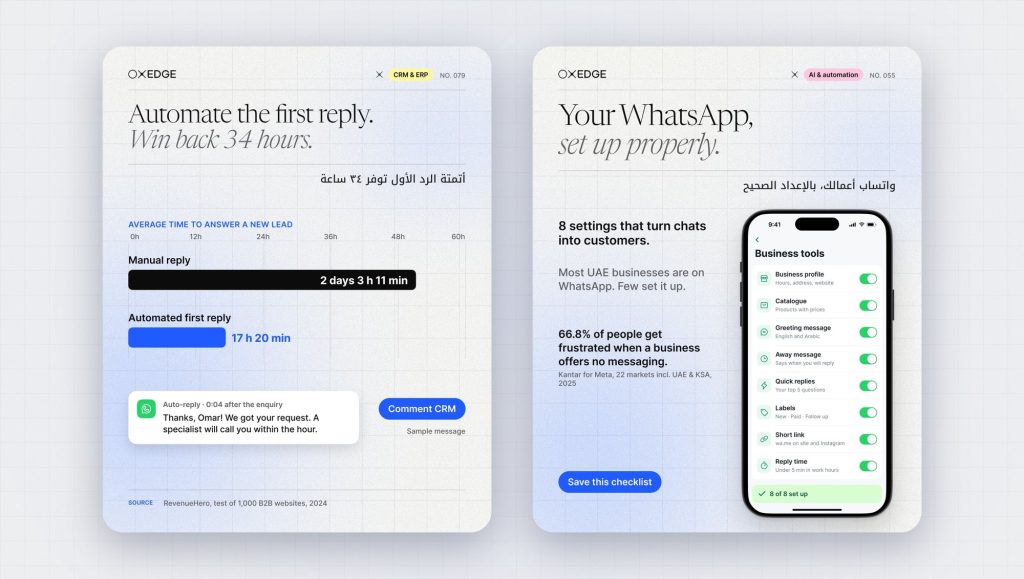
Customers expect to message you. In Kantar research commissioned by Meta, covering 11,056 adults in 22 markets including the UAE, 66.8 per cent said they feel frustrated when a business does not offer messaging as a way to get in touch. Answering instantly at 11 pm matters, because the alternative is a lead that has already messaged your competitor.
Speed is the measurable gain. When RevenueHero submitted demo requests to 1,000 B2B software companies in 2024, those replying manually took an average of 2 days, 3 hours and 11 minutes, while those that automated at least the first response replied in 17 hours and 20 minutes on average. It is vendor research on overseas software firms, not UAE data, but a gap of roughly 34 hours is hard to ignore. Our guide to AI customer service in the UAE goes deeper on support.
Source: RevenueHero, We tested lead response times of 1,000 B2B sales teams (20 March 2024)
Lead routing
Leads arrive from your website, portals, Instagram and WhatsApp in different languages and levels of detail. An AI step reads each one, tags service, area, budget and language, and assigns it in your CRM with a short summary. The rules for who gets what stay yours; the AI only does the reading. If your leads still live in spreadsheets, sort out the CRM first.
Document extraction, including Arabic
UAE finance and operations teams retype a lot: supplier invoices, Emirates IDs for onboarding, trade licences for new accounts. Microsoft’s Document Intelligence read model, for example, lists Arabic for both printed and handwritten text. The workflow extracts the fields, checks them against rules (has the licence expired? is the TRN the right format?) and sends anything uncertain to a person.
Source: Microsoft Learn, language support for Document Intelligence Read and Layout
Bookings and reporting
Clinics, salons and property viewings run on the same loop: offer a slot, confirm, remind, reschedule. Automating it on WhatsApp removes most of the back-and-forth. Reporting is the quieter win: an automation that pulls Monday’s numbers from your CRM and store and writes three plain sentences about what changed actually gets read.
How to pick your first workflow
Pick one workflow, not a programme. A good first candidate happens often, follows a process you can describe, has data the AI can reach, and causes little harm when the AI is wrong, because a person catches it. Tick what is true for your workflow.
0 of 10
- It happens at least several times a day, every working week
- We can describe the steps on one page, including what “done” looks like
- The inputs are messages, forms or documents we already receive digitally
- The information needed to act lives in a system we can connect, not in someone’s head
- We have real past examples, in Arabic and English, to test it on
- A wrong answer would be caught by a person before it caused real harm
- We know roughly how many hours or lost leads it costs us today
- One named person owns the workflow and will review the AI’s results
- Customers or staff can always reach a person when the automation cannot help
- We know what personal data it touches and who our AI vendors are
Eight or more: a strong first workflow, so start a small pilot. Five to seven: fix the gaps first, usually documentation, data access or ownership. Four or fewer: pick another workflow, or work through our AI readiness checklist for UAE SMEs before you spend on tools.
How OXEDGE does this
We help UAE businesses find one workflow worth automating, then build it with a person in the loop.
- A short workflow audit: volumes, hand-offs, systems and where time and leads are lost today.
- A test set of your real Arabic, English and mixed-language messages or documents, agreed before anything is built.
- An Arabic-first build on the official WhatsApp Business Platform and your CRM, with confidence thresholds and human handover.
- A handover runbook, so your own team can review results, update content and switch the automation off if needed.
What AI automation is not, and where it fails
AI automation does not replace a process you have never written down, and no model is right every time. Most failures come from four places.
Confident wrong answers
Language models can produce fluent answers that are false, often called hallucination. The fix is design rather than hope: answer only from your own approved documents, keep the scope narrow, let the AI say “I don’t know”, and require approval for anything involving money, contracts or medical and legal advice.
Gulf dialect and mixed languages
“Supports Arabic” often means formal Modern Standard Arabic. UAE customers write in Gulf dialect, in Arabizi (Arabic in Latin letters and numbers) and in English mixed with Arabic. Test on your own messages before you trust any demo; our article on why Arabic chatbots fail on Gulf dialect shows how.
Bad or unreachable data
An automation is only as good as the records it reads. If prices live in last year’s PDF and customer history sits in staff phones, the AI acts on stale facts. PwC found that UAE CEOs see limited AI access to enterprise-wide data as the main barrier to wider impact, and globally only 29 per cent of CEOs say their data is fully accessible to AI systems.
Source: PwC Middle East, 29th Global CEO Survey: UAE findings
No route to a person
An automation that traps customers in a loop costs more than it saves. On WhatsApp it is also a policy issue: the WhatsApp Business Messaging Policy, last updated on 23 September 2026, allows automation in the 24-hour customer service window but requires prompt, clear and direct escalation paths, such as transfer to a human agent in the chat, a phone number or email.
Source: WhatsApp Business Messaging Policy (last updated 23 September 2026)
An automation that traps customers in a loop costs more than it saves.
Data protection basics under the UAE PDPL
Most AI automation touches personal data: names, phone numbers, ID numbers. On the mainland, the governing law is Federal Decree-Law No. 45 of 2021 on the Protection of Personal Data (the PDPL), issued on 20 September 2021 and in force since 2 January 2022. Article 2 excludes, among others, health and banking data covered by their own legislation and free-zone companies with their own data-protection law, such as those in the DIFC and ADGM.
Four provisions matter most for automation. Article 8 expects a processor, such as your AI vendor, to act on your instructions under a contract setting out the scope, purpose and type of data. Article 18 lets people object to automated decisions that have legal effect on them or harm them, with listed exceptions, and requires a person to review such a decision on request. Article 21 requires an impact assessment before high-risk processing, including automated profiling. Articles 22 and 23 govern sending personal data abroad.
Source: UAE Legislation, Federal Decree-Law No. 45 of 2021, Articles 2, 8, 18, 21, 22 and 23
In practice: sign data processing terms with every AI vendor, know where data is stored and processed, collect only what the workflow needs, and keep a person in the loop for decisions affecting someone’s rights or money. This is general guidance, not legal advice; take advice for your entity, free zone and sector.
Starting with AI automation: six steps
A first project should be small enough to finish and measurable enough to judge.
- Choose one workflow using the checklist above, and name one owner for it.
- Measure today: volume per week, time per case, response time and errors, so you can compare later.
- Collect real past examples in every language customers use, with personal details removed.
- Build the smallest version that works: one channel, one language pair, clear rules for what goes to a person.
- Run it with people approving the AI’s output, then automate the cases it gets right consistently.
- Review results every month, update the knowledge base and only then add the next workflow.
The steps are the same on an off-the-shelf platform or with a custom software partner. For budgets, our guide to what AI automation costs in the UAE breaks them down.
Frequently asked questions
Is AI automation the same as RPA?
No. Robotic process automation copies the clicks a person makes in software and follows fixed rules. AI automation adds a step that reads and interprets messy input. Many workflows use both.
What is the difference between a chatbot and an AI agent?
A chatbot answers questions in a conversation. An AI agent can also act through tools, such as booking a slot or updating your CRM, and decides the order of those steps itself. A bot that only answers from your FAQ is not an agent, whatever the brochure says.
Does AI automation work in Arabic?
Yes, with care. Current models read and write Arabic, but quality drops on Gulf dialect, Arabizi and mixed-language messages. Test on your own conversations and have a native speaker review anything customers will read.
Do we need our own AI model?
Almost never for a first workflow. Commercial models, used through a vendor or cloud provider under proper data terms, handle reading, classifying and drafting. What makes the automation yours is your knowledge base, rules and integrations.
Work with OXEDGE
Find the one workflow worth automating first, and build it with a person in the loop.
We would start by mapping where your team loses time and leads today, and score your candidate workflows against volume, data and risk. You leave the first conversation knowing which workflow to automate first, what it needs and how to measure it.