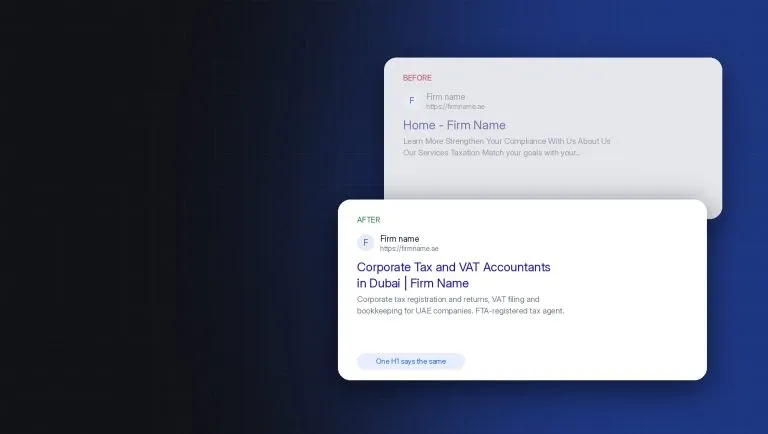

Quick answer: A website redesign in Dubai typically takes two to three months for a bilingual corporate site, in OXEDGE’s delivery experience. The cost depends on page templates, URLs, content, the Arabic version and integrations. Rankings hold only if every old URL is mapped to a permanent redirect before launch, and no one can guarantee them.
A website redesign in Dubai typically runs two to three months for a bilingual corporate site in our delivery experience, costs what your pages, content, Arabic version and integrations add up to, and keeps its Google rankings only if every old URL is mapped and redirected before launch. No one can guarantee rankings will hold, but a documented migration keeps the risk small. This guide covers when to redesign rather than refresh, what moves the cost, a phase-by-phase timeline, the migration steps Google documents, the Arabic version, speed and accessibility targets, a launch checklist with a score, and what to watch in the first 30 days.
Sources: StatCounter, search engine market share in the UAE, September 2026 · Google Search Central, site moves with URL changes · Search Console Help, Change of Address tool · WebAIM Million, 2026 report
Redesign, refresh or rebuild: decide what is actually changing
“Redesign” covers very different projects, and the SEO risk depends on what changes underneath the look. New colours and typography on the same pages carry little risk. A new platform, URL structure or domain carries much more, because Google has to recrawl and reindex the site. Decide which project you’re running before you ask for quotes.
| Project | What changes | URLs | Search risk | Choose it when |
|---|---|---|---|---|
| Visual refresh | Colours, type, images; same pages | Unchanged | Low | The site converts but looks dated |
| Redesign on the same platform | Layouts, navigation, page templates, some content | Mostly unchanged; some merged or renamed | Medium | Visitors cannot find things or the offer has changed |
| Rebuild or replatform | CMS, code, templates, URL patterns, often content | Many change | High without a redirect map | The platform is slow, insecure, hard to edit or weak in Arabic |
| Domain change or merger | The address itself, often with everything above | All change | Highest | A rebrand or several sites merging |
Good reasons to redesign are business reasons: the site produces no enquiries, staff can’t update it, it fails on phones, or the Arabic version is an afterthought. “It feels old” is a reason for a refresh. If traffic is fine but enquiries aren’t, try our checklist for a website that gets visitors but no enquiries first; the fix may be smaller than a redesign.
What drives the cost of a redesign
Typical Dubai price ranges by site type are in our guide to how much a website costs in Dubai, so we don’t repeat them here. A redesign adds one thing a first build doesn’t have: you’re moving an existing site with history, content and rankings, and that move is work in its own right. Ask every agency to price the lines below separately.
| Cost driver | Why it moves the price | How to keep it in check |
|---|---|---|
| Page templates | Each layout is designed, built and tested in two languages | Count templates, not pages |
| URLs to migrate | Every old URL needs a mapped destination and a tested redirect | Share the full URL list before quoting |
| Content rewriting | New copy and photography often take longer than design | Improve pages that already rank rather than replace them |
| Arabic version | Translation, native review and a mirrored right-to-left layout | Design both languages together |
| Platform change | Data migration, new hosting, new plugins, staff retraining | Change platform only for a limitation you can name |
| Integrations | CRM, WhatsApp, booking and payment connections are rebuilt and retested | List every connected system in the brief |
| SEO migration | Benchmarking, redirect mapping, staging checks, monitoring | A named line item, not “SEO included” |
| Speed and accessibility | Meeting measured targets takes design and engineering time | Targets in the acceptance criteria |
VAT at 5 per cent applies if your agency is VAT-registered, and hosting and maintenance continue after launch. Our checklist for choosing a web design agency in Dubai includes an RFP template you can adapt for a redesign.
Source: Federal Tax Authority, VAT
Website redesign in Dubai: a realistic timeline, phase by phase
The phases below assume a bilingual corporate site of 20 to 60 pages with a few integrations. Content and the redirect map run alongside design and build, so the total is shorter than the sum. The slowest part is rarely design: it’s content approval, Arabic review and decisions on the client side.
| Phase | What happens | SEO work | Typical duration |
|---|---|---|---|
| 1. Audit and inventory | Goals, analytics, content and technical audit | Export every indexed URL with traffic, links and top queries | 1 to 2 weeks |
| 2. Scope and content plan | New sitemap, templates, content owners, integrations | Decide which pages stay, merge or go; draft the redirect map | 1 to 2 weeks |
| 3. Design | Wireframes and visual design for both languages, mobile first | Keep the content of ranking pages in the new layouts | 2 to 3 weeks |
| 4. Build and content entry | Development on a password-protected staging site | Titles, canonicals, hreflang, structured data, XML sitemap | 3 to 5 weeks |
| 5. QA and pre-launch | Device, form, speed and accessibility testing in both languages | Test every redirect; crawl staging for broken links | 1 to 2 weeks |
| 6. Launch | Server or DNS switch, live checks | Redirects live, sitemap submitted, noindex removed | 1 day |
| 7. Stabilisation | Fixes, content gaps, team handover | Monitoring of indexing, traffic and errors | At least 4 weeks |
Durations reflect OXEDGE delivery experience with bilingual corporate sites of this size; your scope, content readiness and approval speed will move them.
Plan the launch around your sales calendar. A launch in your busiest season leaves no room for the fluctuations that follow any migration.
Protecting your rankings: the migration steps Google documents
Google publishes step-by-step guidance for moving a site, and following it’s the closest thing to insurance a redesign has. Its advice on hiring an SEO says a great time to bring one in is when you’re considering a redesign, and the earlier the better.
Sources: Google Search Central, site moves with URL changes (updated 20 August 2026) · Google Search Central, do you need an SEO?
Google publishes step-by-step guidance for moving a site, and following it’s the closest thing to insurance a redesign has.
Map every old URL to its new home
Google suggests starting the map with the URLs in your sitemaps, server logs and Search Console links reports. Each old URL should point to the single closest new page; Google warns against redirecting many old URLs to one irrelevant destination such as the home page. Where content is removed with no equivalent, the old URL should return a 404 or 410.
Use permanent, server-side redirects
Use 301 or 308 codes, which Google treats as permanent and as a signal that the new URL should be canonical; temporary 302 and 307 codes don’t send that signal. A server-side redirect has the highest chance of being read correctly, and JavaScript redirects are a last resort. Redirect straight to the final page: chains should ideally have no more than three hops, which matters on sites redesigned before.
Sources: Google Search Central, redirects and Google Search (updated 14 April 2026) · Google Search Central, site moves with URL changes
Keep the content that earns traffic
Rankings belong to pages and their content, not to the design. If a service page ranks for a valuable query, carry its substance, headings and title into the new version, then improve it. Point internal links, canonical tags and hreflang annotations at the new URLs, and publish a sitemap listing them, as Google’s checklist asks.
Change of Address is only for domain moves
The Search Console Change of Address tool is for moving to another domain or subdomain. Google says it isn’t needed for HTTP to HTTPS, www to non-www, path changes or a hosting change with no visible URL changes. When used, it acts for 180 days, and Google’s site move guide says keep redirects for as long as possible, generally at least a year.
Sources: Search Console Help, Change of Address tool · Google Search Central, site moves without URL changes
Keep staging out of Google
Build behind a password: Google says private content needs password protection to stay out of Search. The reverse mistake is just as costly, because a staging noindex tag left in place at launch tells Google not to index the live site.
Source: Google Search Central, control what you share with Google
What no one can promise
Google says plainly that no one can guarantee a number one ranking, and warns that rankings may fluctuate while it recrawls and reindexes a moved site. A small to medium site can take a few weeks for most pages to move. A careful migration limits the dip; it doesn’t make the outcome certain, because competitors, algorithm updates and your new content all play a part. Treat any promise of unchanged rankings as a red flag.
Sources: Google Search Central, do you need an SEO? (updated 5 June 2026) · Google Search Central, site moves with URL changes
The Arabic version and hreflang
A redesign is the right moment to fix how the Arabic site is built. Google recommends a separate URL for each language, such as /ar/, rather than switching through cookies or browser settings, and advises against redirecting visitors automatically based on a guess about their language. Google reads a page’s language from its visible content, so translating only the menus doesn’t make an Arabic page.
Source: Google Search Central, managing multi-regional and multilingual sites
Hreflang tells Google which pages are language versions of each other. Each version must list itself and every other version; if two pages don’t point to each other, Google ignores the tags. A UAE site would use en-AE and ar-AE, plus x-default for everyone else, declared in link tags, HTTP headers or the sitemap. In a migration, update every hreflang annotation to the new URLs at the same time as the redirects.
Source: Google Search Central, hreflang and localised versions of a page (updated 21 September 2026)
Layout matters as much as tags: our guide to Arabic-first UX lists what breaks when a site is simply translated.
How OXEDGE does this
We redesign bilingual sites with the SEO migration planned from week one, not bolted on at launch.
- A benchmark of your URLs, traffic, top queries and links before design starts.
- A URL-by-URL redirect map, reviewed with you and tested on password-protected staging.
- English and Arabic designed together, with hreflang, canonicals and sitemaps built into the templates.
- Core Web Vitals and WCAG 2.2 AA checks on key templates as launch criteria.
- A launch-day runbook and 30 days of monitoring with a written report.
Speed and accessibility: write them into the acceptance criteria
Core Web Vitals
A page passes Google’s Core Web Vitals when Largest Contentful Paint is within 2.5 seconds, Interaction to Next Paint is 200 milliseconds or less and Cumulative Layout Shift is 0.1 or less, at the 75th percentile of page loads on mobile and desktop. Google recommends good Core Web Vitals for success with Search and says they align with what its core ranking systems seek to reward.
Sources: web.dev, Web Vitals · Google Search Central, understanding Core Web Vitals and Google search results
Put these targets in the contract and test key templates on staging with a phone on mobile data. Expect field data to lag: the Search Console report uses real-user data from the previous 28 days, and validating a fix starts a 28-day monitoring session. Keeping the site fast afterwards is covered in our guide to website care after launch.
Source: Search Console Help, Core Web Vitals report
Put these targets in the contract and test key templates on staging with a phone on mobile data.
Accessibility basics
The current standard is WCAG 2.2, published by the W3C on 5 October 2023, with levels A, AA and AAA. The UAE Design System states that federal government entities are instructed to meet level AA of WCAG 2.1. For a private business, AA is a sensible target.
Sources: W3C WAI, WCAG 2 overview · UAE Design System, accessibility guidelines
The common failures are basic. WebAIM’s 2026 scan of the top million home pages found low-contrast text on 83.9 per cent, images without alt text on 53.1 per cent, unlabelled form inputs on 51 per cent and no declared page language on 13.5 per cent. On a bilingual site, set the language and text direction on Arabic pages for screen readers as well as layout.
Source: WebAIM Million, 2026 report
Launch readiness: score your redesign before go-live
Tick each statement that’s true today. Use it a week before launch and again the day before.
0 of 12
- Every indexed old URL is listed with its traffic and links
- Each old URL maps to one closest new page, or returns 404 or 410
- Redirects are server-side 301 or 308, tested, with no chains
- Pages that bring traffic keep their substance, headings and titles
- Internal links, canonicals and the sitemap use the new URLs
- English and Arabic pages carry reciprocal hreflang, plus x-default
- Staging is password protected and no noindex tag will reach the live site
- Key templates meet Core Web Vitals targets on a phone
- Key templates pass a WCAG 2.2 AA check in both languages
- Analytics, form, WhatsApp and call tracking fire on staging
- Search Console is verified and a benchmark of queries is saved
- A rollback plan exists and someone is on call for launch week
Eleven or twelve: ready. Eight to ten: close the gaps before the date. Seven or fewer: move the date; a delay costs less than rebuilding lost traffic.
On launch day, switch the server or DNS, load key pages in both languages, test a sample of old URLs from the map, confirm robots.txt and that noindex is gone, submit the new sitemap, send a test enquiry through every form and WhatsApp button, and check analytics records the visits.
The first 30 days after launch
Google’s guide says that, ideally, traffic on old URLs falls while traffic on new URLs rises, and points to Search Console’s sitemap and indexing reports, server logs and analytics. Compare against your phase one benchmark on matching weekdays.
Source: Google Search Central, site moves with URL changes: monitor traffic
| When | What to check | Where |
|---|---|---|
| First 24 hours | Redirects for the top old URLs, 404 errors, forms, tracking | Crawler, server logs, analytics |
| Days 2 to 7 | New URLs indexed, old URLs dropping out, error spikes | Search Console indexing and sitemaps reports |
| Weeks 2 to 3 | Clicks and impressions for top queries against the benchmark | Search Console performance report |
| Week 4 | Enquiries by source, mobile Core Web Vitals, Arabic pages indexed | Analytics, CRM, Core Web Vitals report |
| Day 30 review | Pages that lost ground, missing redirects, content to restore | A written report with owners |
If a page that used to rank has vanished, check first that its old URL redirects to the right place, then that the new page kept the content that earned the ranking. Both are quick to fix once you see them.
Frequently asked questions
Will our Google rankings drop after a redesign?
They may move for a few weeks while Google recrawls the site, especially if URLs change. A complete redirect map, kept content and correct tags keep the risk small, but nobody can guarantee rankings stay the same.
How long should we keep the old redirects?
Google advises as long as possible, generally at least a year. Keeping them permanently costs little.
Can we redesign in stages?
Yes, and it lowers risk. Redesign one section at a time, keep URLs where possible, and launch outside your busiest season.
How much does a website redesign cost in Dubai?
It depends on page templates, URLs to migrate, content rewriting, the Arabic version, any platform change, integrations, the SEO migration and your speed and accessibility targets. Ask every agency to price those lines separately. VAT at 5 per cent applies if the agency is VAT-registered.
How long does a website redesign take in Dubai?
For a bilingual corporate site of 20 to 60 pages, about two to three months in OXEDGE’s experience, with stabilisation of at least four weeks after launch. The slowest part is rarely design. It’s content approval, Arabic review and client-side decisions.
Do we need hreflang for the Arabic version?
Yes. Google recommends a separate URL for each language, such as /ar/. Each version must list itself and every other version, using en-AE and ar-AE plus x-default. In a migration, update every hreflang annotation at the same time as the redirects.
Work with OXEDGE
Redesign your site without gambling the traffic it already earns.
We would start by benchmarking your current URLs, traffic and enquiries, and show you which pages carry the most search value. You leave the first conversation with a clear scope, a realistic timeline and the SEO risks named up front.