
Quick answer: A school seats page answers the first question a parent asks a Dubai school: is there a place in this year group? Put one table on one page, with each year group, a plain status (open, limited places, waiting list, full), the date you last updated it and the age rule for entry. Then say how to apply or join the waiting list, add WhatsApp and write an Arabic version.
Parents shortlist Dubai schools on their phones long before they book a tour. They read the rating and fee sheet in the KHDA directory, then open the school’s website for the one thing the directory can’t tell them: can my child start in Year 4 next September? In our October study of 154 Dubai school websites, 82 per cent took online applications, but only 36 per cent said anything about seats or a waiting list. This guide shows how to build one school seats page that answers the question in the first screen, in English and Arabic, without promising places you can’t give.
Key takeaways
- Answer “is there a place?” on the page itself, by year group, with a date. A parent who has to ask will often ask the next school instead.
- Use four status words and give each a single meaning, so “limited places” never means two things.
- State the entry age rule in plain words, because KHDA changed the admission ages for children registering for the first time.
- Say what a waiting list does and doesn’t promise, and what the family needs to do next.
- Add a WhatsApp button and an Arabic page. Only 26 per cent of school sites linked WhatsApp and 10 per cent had Arabic.
Source: OXEDGE study of 154 Dubai school websites, 20 October 2026 · Gulf News, KHDA Media Majlis report, 1 October 2026 (406,563 students, as cited in the OXEDGE study).
The question parents ask first
A family moving to Dubai, or changing schools, has a short list of questions: is there a place, what does it cost, when can we visit, how do we apply. Fees and applications are the part schools already publish: 86 per cent of the sites we checked showed fees or a fee document and 82 per cent had an online application. The seats answer is the missing step between them. Without it, the parent fills in a form for a school that may be full, or leaves before applying.
The market makes the question more urgent, not less. Dubai’s private schools had 406,563 students at the start of 2026-27, 4.6 per cent more than in June 2026, and fees are frozen for the year, so price won’t separate two schools. A clear seats answer will.
Source: OXEDGE study of 154 Dubai school websites, 20 October 2026 (enrolment from Gulf News, 1 October 2026; fee freeze from KHDA, 22 May 2026).
Parents don’t expect every year group to be open. They expect the website to tell them, so they can plan instead of guess.
The school seats page, part by part
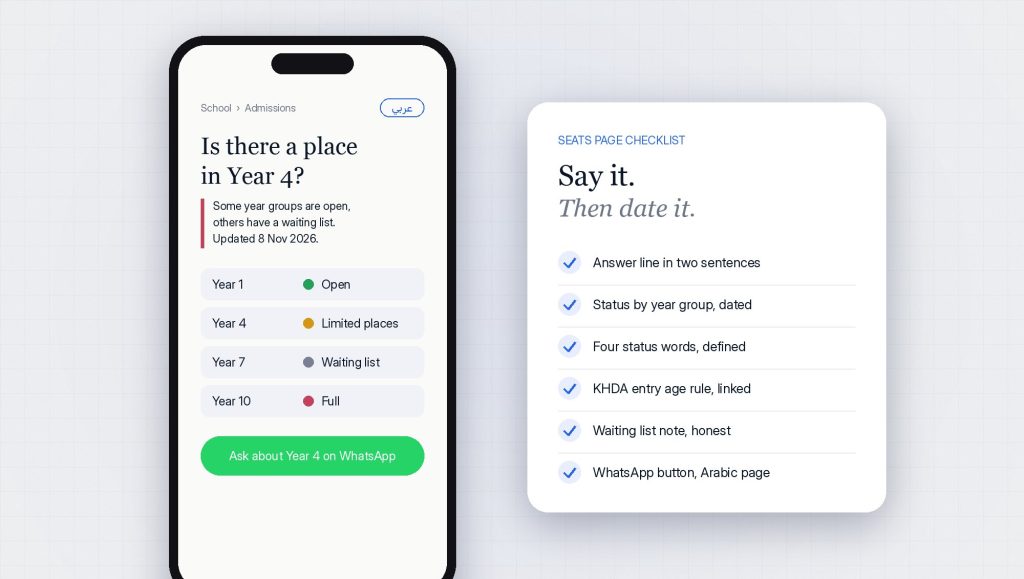
One screen on a phone should show the answer: the school name, the academic year, the table of year groups and a WhatsApp button. Everything below it answers a follow-up. Write only what your admissions policy and your registrar’s records support, and date it.
| Page part | What it does | What to write |
|---|---|---|
| Answer line | Gives the headline in two sentences | “We have places in some year groups for September 2027 and waiting lists in others. The table below was updated on [date].” |
| Seats table | Shows each year group’s status | Year group, status word, and the date, one row per year group |
| Age rule | Tells parents which year their child can enter | The KHDA entry ages, in plain words, with a link to the source |
| Waiting list | Sets honest expectations | What joining involves, what it doesn’t guarantee and how families are told |
| How to apply | Gives the next step | Apply link, documents to have ready, tour booking link |
| Contact | Lets a parent ask a short question | A WhatsApp button with a prefilled message naming the year group |
Page layout reflects OXEDGE experience with UAE school websites.
Four status words, one meaning each
Most school sites that mention seats do it in a sentence on a FAQ page, in different words each time. Pick four statuses and define them once, on the page, so staff and parents read them the same way.
| Status | What it means | What the parent does |
|---|---|---|
| Open | Places are available now, subject to assessment and documents | Apply online and book a tour |
| Limited places | A small number remain; the school decides how many to show | Apply soon and book a tour |
| Waiting list | No place now; families are added in line with your admissions policy | Join the list, then ask about timing on WhatsApp |
| Full | No places and no list for this year group this year | Ask about next year or another year group |
Status wording is an OXEDGE suggestion; define the terms to match your own admissions policy.
Say the entry age in plain words
KHDA changed the admission ages for the 2026-27 year. For children registering in the KHDA system for the first time, and for schools starting in September, a child must reach the required age by 31 December: three for Pre-KG or FS1, four for KG1 or FS2, five for KG2 or Year 1 and six for Grade 1 or Year 2. For April-start schools the date is 31 March. The rule doesn’t apply to children already enrolled or transferring within Dubai, and for 2026-27 there is a one-time exception for children born between 1 September and 31 December 2022 who aren’t enrolled anywhere, who the school may place in FS1 or FS2 based on developmental readiness.
Source: Gulf News, Dubai schools 2026-27: the four major rules every UAE parent needs to know, last updated 7 August 2026, opened 8 November 2026.
Put the rule next to the seats table, in two sentences, and link the KHDA source. A parent comparing a September 2027 start doesn’t want to work out whether their child counts as Year 1 or Year 2. Check the rule against KHDA’s current guidance each year before you publish, because it can change.
Be honest about the waiting list
A waiting list is a queue the school manages, not a promise. Say so. Explain who is added, what the family has to do (for example, submit the application and any documents), how and when you will contact them, and whether sibling or staff priority applies under your admissions policy. Don’t quote waiting times unless the registrar can stand behind them. A sentence such as “movement depends on families’ plans, so we can’t give a date” is more useful than a guess, and it stops the same question reaching your inbox ten times.
From admissions policy to live page: five steps
Workflow reflects OXEDGE experience with UAE school websites.
Step 1: pick the year groups
List every year group you teach and the entry age for each, taken from KHDA’s guidance, not from last year’s page.
Step 2: agree the status words
Use the four statuses above, or your own, but define them in one place and use nothing else. The registrar and the admissions team should read each word the same way.
Step 3: name one owner
One person, usually the registrar, updates the table and the date once a week during enrolment season and once a month after. A stale table is worse than none, because parents trust the date.
Step 4: write the page, answer first
Open with the two-sentence answer, then the table, the age rule, the waiting list note and how to apply. Add a click-to-chat link with a prefilled message such as “I would like to ask about a place in Year 4”. If enquiries arrive out of hours, a WhatsApp AI agent can answer the first questions and pass the family to the admissions team in the morning.
Step 5: add the Arabic page
Have an Arabic writer produce a real Arabic page with its own title and link the two versions. Our Arabic website study shows how rare this is across UAE sites, and only 10 per cent of the school sites we checked had one.
How OXEDGE does this
We build the seats page into your admissions section, with a form your registrar can update in a minute.
- A seats table by year group with four status words, a last-updated date and the entry age rule.
- A simple admin screen so the registrar changes a status without a developer.
- A WhatsApp button with a prefilled message per year group, and an optional first-reply assistant.
- A written Arabic version linked to the English page, with its own title and description.
What not to put on the page
Don’t promise a place, a start date or an outcome of an assessment. Don’t publish a status you haven’t confirmed with the registrar, and don’t leave last year’s table up with a new date. Don’t show a child’s or family’s name anywhere. Don’t quote fees on this page unless they come from your approved KHDA fee sheet. This is general guidance, not legal advice; follow your admissions policy and KHDA’s current rules.
Score your seats page
Tick what’s true for your school today. Below five, start with the first three items.
0 of 8
- A page answers “is there a place?” in the first two sentences
- Every year group has a status word and a last-updated date
- The four status words are defined on the page
- The KHDA entry age rule is stated and linked
- The waiting list note says what it does and doesn’t promise
- The apply link and tour booking link sit on the same page
- A WhatsApp button opens a prefilled message naming the year group
- An Arabic version exists with its own title
See how we approach this for schools on our school websites page, and more sites we have designed in the OXEDGE portfolio.
Questions Dubai schools ask
Should we show exact numbers of places?
You don’t have to. A status word per year group is enough, and it avoids promising a number that changes by the day. Show a number only if the registrar can keep it current.
Won’t a “full” label put parents off?
It saves them a form and saves your team an enquiry. Pair it with a waiting list option or a note about other year groups so the parent still has a next step.
How often should we update the table?
Weekly during peak enrolment, monthly otherwise, and always with the date on the page. If you can’t keep to that, show fewer year groups and say how to ask.
Is an Arabic version worth it?
Yes. Few school sites have one, and Arabic-speaking parents search in Arabic. Use a written Arabic page, not a machine translation.
Work with OXEDGE
Get a free seats page plan for your school, in English and Arabic.
We review your admissions page, WhatsApp and Arabic coverage and send back a short plan for your school website.